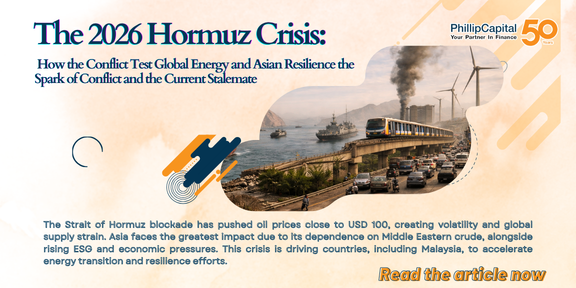
The global energy landscape was irrevocably altered on February 28, 2026, when a joint military campaign by the United States and Israel targeted the Iranian regime, aiming to neutralize its strategic infrastructure. This offensive triggered a “worst-case scenario” for global trade: the retaliatory closure of the Strait of Hormuz by Tehran. As the primary artery for nearly 20% of the world’s petroleum and liquefied natural gas (LNG), the Strait’s blockage has plunged the global economy into its most severe energy disruption in decades. As of April 13, 2026, the crisis has reached a critical juncture. Following the collapse of high-stakes peace negotiations in Islamabad over the weekend, the market has entered a period of extreme volatility. Today, Brent crude prices surged by approximately 8%, climbing back toward the USD 100 per barrel mark. While prices hit a peak of USD 120 earlier in the conflict, the current plateau reflects a market that has resigned itself to a prolonged blockade rather than a short-term shock.
Exhibit 1: Brent Crude Oil Price Chart
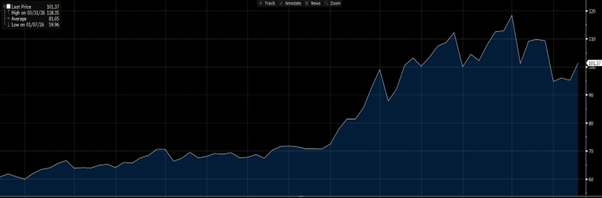
Source: Bloomberg, PCM, 13 April 2026
The Asian Epicenter of Supply Chain Vulnerability
Asia has emerged as the clear epicenter of this crisis due to its structural dependence on Middle Eastern crude. Nations such as Japan, South Korea, Vietnam, and the Philippines rely on the Strait for 75% to 95% of their crude supply, leaving them with little room to maneuver as strategic reserves begin to dwindle. In comparison, while Europe remains sensitive to the conflict, its dependency on the Strait varies between 10% and 13% for major economies like Spain and France. For Asian nations, the crisis has fundamentally tested fuel resilience, forcing a rapid and difficult reassessment of national energy security. Supply chains have reached a breaking point; with storage facilities at capacity and production in the Gulf largely at a standstill, the disruption is no longer just a pricing issue but a physical shortage that threatens the industrial output of the world’s most manufacturing-heavy region.
The ESG Toll: Environmental and Social Consequences
Beyond the immediate economic impact, the conflict is exposing multi-dimensional ESG vulnerabilities across the continent. On the environmental front, the disruption is actively slowing progress toward decarbonization. To maintain power grid stability, countries like Japan and South Korea have been forced to revert to coal-fired power or other carbon-intensive energy sources to compensate for lost LNG shipments. Socially, the surge in fuel costs has triggered inflationary pressures that threaten food security. In India, rising transportation costs have driven up the price of basic staples, while in Malaysia and Indonesia, the increased cost of fuel and fertilizer is straining household affordability and agricultural productivity. This crisis highlights that energy security is not a standalone issue but a social determinant that affects the most vulnerable populations first.
A Structural Shift Toward Strategic Resilience
In Malaysia and throughout the ASEAN region, the narrative is shifting decisively toward domestic energy sovereignty. Higher fossil fuel prices have made solar, wind, and geothermal energy suddenly competitive, prompting governments to fast-track renewable projects and regional power integration. This conflict has transformed energy security from a theoretical policy goal into an immediate survival mandate.
To manage immediate demand, governments have introduced drastic consumption-side measures. For example, In Malaysia, a nationwide work-from-home (WFH) directive for the public sector. This initiative aims to curb national fuel consumption and reduce the fiscal strain on the state. Simultaneously, the crisis has accelerated the politically sensitive dismantling of blanket fuel subsidies. Governments are pivoting toward “targeted agility,” replacing broad subsidies with specific cash transfers like the Budi Madani scheme to protect the vulnerable while allowing market prices to discourage wasteful consumption. The global community remains in a state of uncertainty as mixed signals continue to emerge regarding the reopening of the waterway, yet the trend is clear.
Our View
The key lesson for Asia is the necessity of moving beyond efficiency-driven supply chains toward models built on resilience. While the short-term outlook is marked by strain, the 2026 Hormuz blockade may ultimately be remembered as the catalyst that accelerated Asia’s transition toward a more sustainable energy future.
Disclaimer
The information contained herein does not constitute an offer, invitation, or solicitation to invest in any product or service offered by Phillip Capital Management Sdn Bhd (“PCM”). No part of this document may be reproduced or circulated without prior written consent from PCM. This is not a unit trust or collective investment scheme and is not an obligation of, deposit in, or guaranteed by PCM. All investments carry risks, including the potential loss of principal.
Performance figures presented may reflect model portfolios and may differ from actual client accounts’ performance. Variations in individual clients’ portfolios against model portfolios and between one client’s portfolio to another can arise due to multiple factors, including (but not limited to) higher relative brokerage costs for smaller portfolios, timing of capital injections or withdrawals, timing of purchases and sales, and mandate change (e.g., Shariah vs. conventional). These differences may impact overall performance.
Past performance is not necessarily indicative of future returns. The value of investments may rise or fall, and returns are not guaranteed. PCM has not considered your investment objectives, financial situation, or particular needs. You are advised to consult a licensed financial adviser before making any investment decisions.
While all reasonable care has been taken to ensure the accuracy and completeness of the information contained herein, no representation or warranty is made, and no liability is accepted for any loss arising directly or indirectly from reliance on this material. This publication has not been reviewed by the Securities