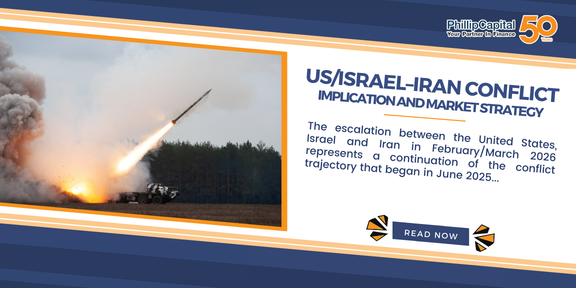
The escalation between the United States, Israel and Iran in February/March 2026 represents a continuation of the conflict trajectory that began in June 2025. The earlier confrontation was triggered when Israel conducted large‑scale strikes against Iranian nuclear and military facilities, prompting Iran to launch missiles and drones toward Israeli targets. The United States subsequently expanded the operation by striking Iran’s nuclear infrastructure, signalling a readiness to intervene directly to limit Iran’s nuclear capabilities. This framework has shaped the current episode.
The latest flare‑up began in late February 2026 with a coordinated round of U.S.–Israeli strikes targeting Iran’s military assets and elements of its leadership structure. Iran responded with missile attacks across multiple regional locations. Based on the structure of both episodes (2025 and 2026), the present conflict is best characterised as a protracted and episodic confrontation in our view, rather than a precursor to full‑scale war.
From a market standpoint, the disruption risk surrounding the Strait of Hormuz is the principal channel affecting global pricing. Approximately one‑fifth of global oil supply passes through this corridor, and temporary restrictions have elevated short‑term risk premiums. Brent crude now briefly moved toward the US$82 range, consistent with typical conflict‑driven price dynamics in the region. Historically, oil price spikes linked to geopolitical events tend to normalise unless supply constraints become persistent. As current disruptions have not yet translated into sustained physical shortages, the prevailing assessment is that oil markets will stabilise once clarity on shipping conditions improves.
Safe‑haven flows have been observed across precious metals, with gold rising above US$5,300 per ounce. This movement reflects standard risk‑management behaviour during geopolitical stress rather than a structural shift in the underlying fundamentals. Unless tension materially broadens or extends, gold is expected to remain supported but not necessarily embark on a sustained upward trajectory.
For Malaysia, the implications are primarily second‑order. Direct trade exposure to Iran is minimal, and domestic demand drivers remain intact. However, the principal transmission mechanism is through oil prices and fiscal cost pressures, particularly regarding the RON95 fuel subsidy, currently estimated at roughly RM9 billion under normalised crude assumptions. Should crude remain elevated for an extended period, subsidy outlays would increase proportionately, with potential implications for the fiscal consolidation path. Financial markets may also experience intermittent volatility due to shifting global risk sentiment, although such movements are unlikely to alter Malaysia’s medium‑term macro trajectory.
In light of the above, our preferred positioning strategy is to maintain emphasis on domestic‑centric sectors, particularly banking and consumer‑related sectors, alongside quality names and high dividend yielders. These sectors/stocks offer more stable earnings visibility and limited sensitivity to external geopolitical volatility.
In short, our assessment suggests that the February–March 2026 escalation should be interpreted as part of a broader pattern of recurring regional conflict episodes rather than a structural break in geopolitical conditions. Markets are likely to continue reacting to headlines, but the underlying economic impact remains contained unless the Strait of Hormuz faces prolonged or severe disruption.
We believe PMART/PMA Dividend Enhanced and/or PMART/PMA Dividend Enhanced ESG may offer a defensive positioning during periods of uncertainty, given their exposure to high dividend-yielding equities with a strong domestic focus. We apply the Dog of the Dow approach, screen and select top market cap stocks to minimise risk and ensure consistent performance. The portfolio is an equal weighting portfolio which reduces concentration risk and provides similar exposure to all clients, both initially and after rebalancing. We offer both conventional and Shariah investment options to cater to the diverse needs of our investors. Click here to learn more. We recently also introduced PMART/PMA Dividend Enhanced ESG Mandate as we remain dedicated to investing in ESG stocks given their stronger valuation and profitability. Finally, Phillip Dividend Fund may also be a suitable consideration for investors seeking defensive return profile and stability during periods of market uncertainty.
Disclaimer
The information contained herein does not constitute an offer, invitation, or solicitation to invest in any product or service offered by Phillip Capital Management Sdn Bhd (“PCM”). No part of this document may be reproduced or circulated without prior written consent from PCM. This is not a unit trust or collective investment scheme and is not an obligation of, deposit in, or guaranteed by PCM. All investments carry risks, including the potential loss of principal.
Performance figures presented may reflect model portfolios and may differ from actual client accounts’ performance. Variations in individual clients’ portfolios against model portfolios and between one client’s portfolio to another can arise due to multiple factors, including (but not limited to) higher relative brokerage costs for smaller portfolios, timing of capital injections or withdrawals, timing of purchases and sales, and mandate change (e.g., Shariah vs. conventional). These differences may impact overall performance.
Past performance is not necessarily indicative of future returns. The value of investments may rise or fall, and returns are not guaranteed. PCM has not considered your investment objectives, financial situation, or particular needs. You are advised to consult a licensed financial adviser before making any investment decisions.
While all reasonable care has been taken to ensure the accuracy and completeness of the information contained herein, no representation or warranty is made, and no liability is accepted for any loss arising directly or indirectly from reliance on this material. This publication has not been reviewed by the Securities Commission Malaysia.