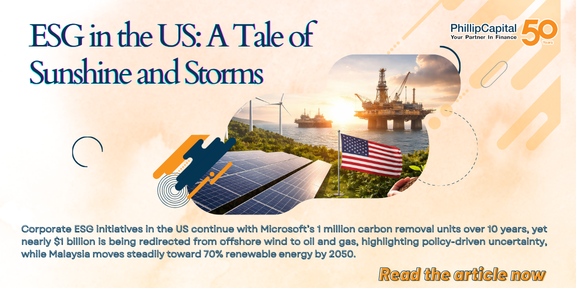
The ESG landscape in the United States is increasingly resembling a season of contrasts — where bright optimism and policy uncertainty coexist. Recent developments show that while corporate and financial players continue to push sustainability forward, government actions are simultaneously creating headwinds for certain segments of the energy transition.
On the sunny side, corporations remain committed to advancing climate initiatives. A clear example is Microsoft, which recently entered a long-term agreement with Liferaft to purchase one million carbon removal units over ten years. The deal, one of the largest of its kind in the US, uses biochar technology — a process that converts biomass into a stable form of carbon that can be stored in soil for centuries. Beyond reducing emissions, the initiative also supports agricultural productivity and creates jobs in rural communities, illustrating how ESG can generate both environmental and economic benefits. Microsoft’s continued leadership in carbon removal also reinforces its broader ambition to become carbon negative by 2030.
At the same time, financial institutions are actively channeling capital into the next phase of clean energy innovation. Banks such as RBC Capital Markets, Barclays, and HSBC are supporting projects led by Fervo Energy, focusing on enhanced geothermal systems (EGS). Unlike traditional renewables like wind and solar, geothermal energy can provide stable, around-the-clock power, making it an increasingly attractive solution for balancing sustainability with energy reliability. The growing involvement of global lenders signals confidence that such technologies could become a core component of future energy infrastructure, highlighting how ESG investing is evolving toward more scalable and dependable solutions.
However, the broader policy environment presents a stark contrast. The Trump Administration has taken a firm stance against offshore wind development, most notably through an agreement with TotalEnergies to halt its US wind projects. In exchange, the government will reimburse nearly $1 billion in lease costs, with the capital redirected into oil, gas, and LNG developments. This move reflects a broader shift in priorities, with the administration citing concerns over cost, reliability, and subsidy dependence of wind energy, while emphasizing the role of traditional energy sources in ensuring affordability and energy security.
Taken together, these developments underscore a key reality: ESG in the US is no longer moving in a single, unified direction. Instead, it is becoming increasingly fragmented — with corporations and capital markets driving innovation and sustainability, while policy decisions introduce new layers of uncertainty. For investors, this creates a more nuanced landscape — one that requires greater selectivity, deeper understanding of policy risks, and a focus on areas where long-term structural momentum remains intact.
Malaysia: Positioned for the Energy Transition
Malaysia, unlike the US, is advancing its energy agenda, supported by the National Energy Transition Roadmap (NETR), which sets out clear, measurable targets. Under the roadmap, Malaysia aims to increase renewable energy capacity to 31% of installed capacity by 2025, rising to 40% by 2035 and 70% by 2050. The country has also committed to achieving net-zero emissions as early as 2050, alongside plans to develop a domestic hydrogen economy and scale up energy storage solutions.
These targets are complemented by initiatives to modernise grid infrastructure and mobilise significant investment into green technologies, positioning Malaysia as a regional leader in the energy transition. As execution gains traction, the country stands to benefit not only from improved energy security, but also from sustained capital inflows into its renewable and transition-linked sectors.
Disclaimer
The information contained herein does not constitute an offer, invitation, or solicitation to invest in any product or service offered by Phillip Capital Management Sdn Bhd (“PCM”). No part of this document may be reproduced or circulated without prior written consent from PCM. This is not a unit trust or collective investment scheme and is not an obligation of, deposit in, or guaranteed by PCM. All investments carry risks, including the potential loss of principal.
Performance figures presented may reflect model portfolios and may differ from actual client accounts’ performance. Variations in individual clients’ portfolios against model portfolios and between one client’s portfolio to another can arise due to multiple factors, including (but not limited to) higher relative brokerage costs for smaller portfolios, timing of capital injections or withdrawals, timing of purchases and sales, and mandate change (e.g., Shariah vs. conventional). These differences may impact overall performance.
Past performance is not necessarily indicative of future returns. The value of investments may rise or fall, and returns are not guaranteed. PCM has not considered your investment objectives, financial situation, or particular needs. You are advised to consult a licensed financial adviser before making any investment decisions.
While all reasonable care has been taken to ensure the accuracy and completeness of the information contained herein, no representation or warranty is made, and no liability is accepted for any loss arising directly or indirectly from reliance on this material. This publication has not been reviewed by the Securities Commission Malaysia.