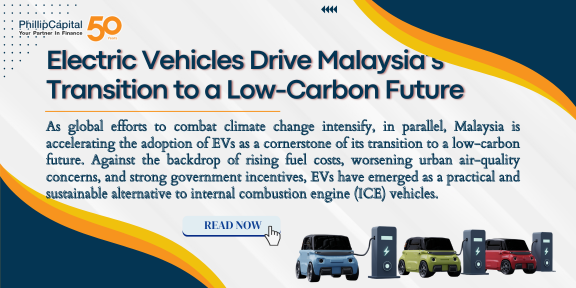
As global efforts to combat climate change intensify, in parallel, Malaysia is accelerating the adoption of electric vehicles (EVs) as a cornerstone of its transition to a low-carbon future. Against the backdrop of rising fuel costs, worsening urban air-quality concerns, and strong government incentives, EVs have emerged as a practical and sustainable alternative to internal combustion engine (ICE) vehicles.
At the industry level, homegrown automakers are stepping up their efforts. Notably, Proton launched its second car, the e.MAS 5, priced from around RM59,800, making EV ownership more accessible to the mass market. At the same time, Perodua unveiled its first battery-electric model, the QV-E, on 1 December 2025, signalling a major move towards electric mobility by the nation’s second domestic automaker.
From a policy perspective, Malaysia is leveraging electric mobility as part of its commitment to achieving net-zero emissions by 2050. Specifically, the National Energy Transition Roadmap (NETR) sets an ambitious target for EVs to account for 80% of Total Industry Volume (TIV) by 2050. This target is particularly significant given the rapid growth in electric vehicle adoption, with battery electric vehicle (BEV) registrations accounting for just 0.42% of total vehicle registrations in 2022 (3,124 units), rising to 1.27% in 2023 (10,159 units), and further increasing to 2.54% in 2024 (21,789 units). Notably, as of November 2025, the EV share had reached 7% of monthly TIV, underscoring the accelerating pace of adoption. In doing so, the NETR seeks to decarbonise the transport sector, stimulate green growth, and strengthen national energy security. Importantly, this target builds upon earlier policy frameworks, including the National Energy Policy 2022–2040 (NEP) and the Low Carbon Mobility Blueprint 2021–2030 (LCMB). Taken together, these initiatives position EV adoption as a central pillar of Malaysia’s transition towards a cleaner, more resilient, and future-ready transport system.
Why Electric Vehicles Are the Next Game Changer
From an economic standpoint, electric vehicles offer clear competitive advantages over ICE vehicles. For instance, charging an EV is generally cheaper than refuelling a conventional vehicle, particularly as electricity tariffs tend to be more stable than fuel prices. According to Tenaga Nasional Berhad (TNB), operating an EV in Malaysia can be between 11.4% and 28.3% cheaper than running a petrol vehicle using RON95 fuel. In addition, EVs require significantly less routine maintenance due to their simpler mechanical design, thereby making them a financially attractive option over the long term.
Beyond cost considerations, EVs represent a major leap forward in energy efficiency. In practical terms, electric drivetrains typically convert around 80–90% of energy into motion, compared to only 20–30% efficiency for internal combustion engines. Consequently, this superior efficiency aligns closely with Malaysia’s national energy optimisation goals, enabling the transport sector to deliver higher output with lower overall energy consumption. As a result, widespread EV adoption can enhance national energy productivity and reduce dependence on fossil fuels, while supporting the NETR target of achieving a 31% renewable energy mix by 2025.
Furthermore, as Malaysia continues to increase the share of renewable energy in its electricity generation mix, the overall carbon footprint of EVs will progressively decline. Over time, this will reinforce their role in reducing greenhouse gas emissions and supporting the country’s long-term climate commitments.
Looking Ahead
Looking forward, the rapid growth of Malaysia’s EV ecosystem has been underpinned by strong and targeted government incentives aimed at encouraging both consumer adoption and industry investment. To begin with, these include full exemptions from import and excise duties for completely built-up electric vehicles, alongside a 100% road tax exemption for EV owners until the end of 2025. Moreover, the government has extended tax incentives for local EV assembly and component manufacturing through 2032.
At the same time, these fiscal measures are being complemented by initiatives to expand and strengthen charging infrastructure nationwide. In this way, a robust and reliable ecosystem is being put in place to support long-term EV adoption. Ultimately, these policies underscore the government’s strong commitment to accelerating Malaysia’s transition towards cleaner, more sustainable mobility and a low-carbon future.
At PCM, we offer PMART and PMA ESG, discretionary portfolio solutions that invest in equities with high ESG ratings drawn from the F4GBM and F4GBMS Indices. Both conventional and Shariah-compliant options are available. PMART and PMA ESG are designed for investors seeking to optimise risk-adjusted returns through a well-diversified portfolio of sustainable, ESG-focused companies. Exhibits 1–4 illustrate the performance of the PMART ESG portfolios under both conventional and Shariah mandates. Notably, PCM’s ESG portfolios have delivered commendable year-to-date (YTD) 2025 performance despite broader market weakness, outperforming the F4GBM and F4GBMS indices. This outperformance has been supported by disciplined stock selection, prudent risk management, and a strong focus on highly rated ESG companies.
Exhibit 1: Phillip PMART ESG Conservative Portfolio Performance
| YTD | 1Y | 2Y | 3Y | 5Y | |
| Phillip PMART ESG Conservative Portfolio | 2.25% | 4.73% | 22.63% | ||
| F4GBM | -4.11% | -0.37% | 12.67% | 15.29% |
Exhibit 2: Phillip PMART ESG Aggressive Portfolio Performance
| YTD | 1Y | 2Y | 3Y | 5Y | |
| Phillip PMART ESG Aggressive Portfolio | 2.25% | 4.73% | 22.63% | ||
| F4GBM | -4.11% | -0.37% | 12.67% | 15.29% |
Exhibit 3: Phillip PMART ESG Shariah Conservative Portfolio Performance
| YTD | 1Y | 2Y | 3Y | 5Y | |
| Phillip PMART ESG Shariah Conservative Portfolio | 0.76% | 2.36% | 10.46% | 11.85% | |
| F4GBMS | -3.42% | 0.53% | 11.26% | 15.44% |
Exhibit 4: Phillip PMART ESG Shariah Aggressive Portfolio Performance
| YTD | 1Y | 2Y | 3Y | 5Y | |
| Phillip PMART ESG Shariah Aggressive Portfolio | 0.76% | 2.36% | 10.46% | 11.85% | |
| F4GBMS | -3.42% | 0.53% | 11.26% | 15.44% |
Source: PCM, 31 October 2025, link
Please click on the link to learn more or email us at cse.my@phillipcapital.com.my if you require any further information.
Disclaimer
The information contained herein does not constitute an offer, invitation, or solicitation to invest in any product or service offered by Phillip Capital Management Sdn Bhd (“PCM”). No part of this document may be reproduced or circulated without prior written consent from PCM. This is not a unit trust or collective investment scheme and is not an obligation of, deposit in, or guaranteed by PCM. All investments carry risks, including the potential loss of principal.
Performance figures presented may reflect model portfolios and may differ from actual client accounts’ performance. Variations in individual clients’ portfolios against model portfolios and between one client’s portfolio to another can arise due to multiple factors, including (but not limited to) higher relative brokerage costs for smaller portfolios, timing of capital injections or withdrawals, timing of purchases and sales, and mandate change (e.g., Shariah vs. conventional). These differences may impact overall performance.
Past performance is not necessarily indicative of future returns. The value of investments may rise or fall, and returns are not guaranteed. PCM has not considered your investment objectives, financial situation, or particular needs. You are advised to consult a licensed financial adviser before making any investment decisions.
While all reasonable care has been taken to ensure the accuracy and completeness of the information contained herein, no representation or warranty is made, and no liability is accepted for any loss arising directly or indirectly from reliance on this material. This publication has not been reviewed by the Securities Commission Malaysia.