
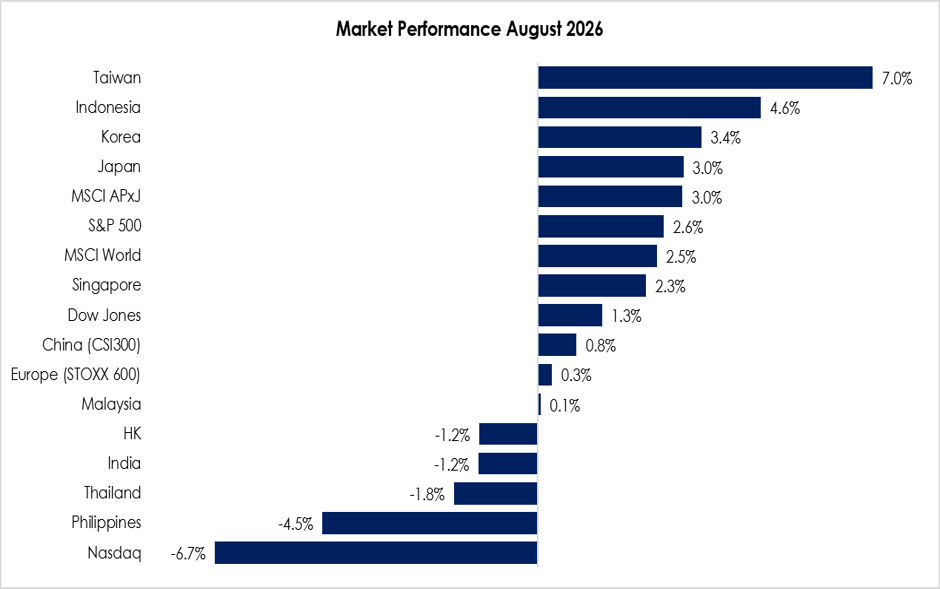
The MSCI Asia Pacific ex-Japan Index (+3.0%) rebounded in August, outperforming the MSCI World Index by 0.5ppt, as renewed optimism over the AI CapEx upcycle lifted sentiment across the region. Sentiment was further supported by easing concerns over near-term US monetary tightening. At the country level, Taiwan (+7.0%) led gains, underpinned by continued optimism over AI infrastructure and upward earnings revisions. Meanwhile, Indonesia (+4.6%) rebounded, although it remained the regional laggard, down 24.5% YTD. South Korea (+3.4%) extended its gains, with YTD returns reaching +61.8%, supported by sustained demand for memory chips and broader semiconductor products. Singapore (+2.3%) advanced, while China (+0.8%) and Malaysia (+0.1%) posted modest gains. By contrast, the Philippines (-4.5%) was the weakest-performing market, followed by Thailand (-1.8%), India and Hong Kong (-1.2%). Domestic growth concerns, coupled with the geopolitical crisis in the Middle East, contributed to selling pressure across these markets.
On the monetary policy front, Bank Indonesia maintained its BI-Rate at 5.75% at its 18–19 August 2026 meeting, prioritising rupiah stability and inflation control. Meanwhile, the Bank of Korea raised its Base Rate by 25 bps to 3.00% on 27 August amid rising inflationary pressure, robust semiconductor exports and strength in the housing market. Regional policymakers remained cautious as they balanced domestic growth against currency volatility, energy-related inflation and uncertainty surrounding US monetary policy.
Exhibit 1: Market Performance August 2026
Source: Bloomberg, PCM, 31 August 2026
The MSCI World Index gained 2.5% during the month, supported by positive returns across most Developed Markets, despite a sharp correction in technology-heavy equities. Japan (+3.0%) led market gains, underpinned by continued foreign investor interest, corporate governance reforms and resilient performance among AI-related semiconductor companies. The US market was mixed, with the S&P 500 (+2.6%) and Dow Jones (+1.3%) advancing as investor interest broadened beyond technology stocks, while the Nasdaq (-6.7%) declined sharply amid profit-taking and concerns over elevated valuations following its earlier AI-driven rally. Europe (+0.3%) recorded a modest gain as resilient corporate earnings were partly offset by persistent geopolitical uncertainty and cautious sentiment surrounding inflation and interest rates. Overall, Developed Market sentiment remained supported by strong corporate earnings and reduced expectations of near-term US monetary tightening, although elevated bond yields and inflation risks continued to temper market optimism.
The KLCI registered a marginal +0.1% MoM gain in Aug 26 (Jul 26: +3.7% MoM), with most sectors outperforming, led by Utilities and Construction. Technology remained the top-performing sector YTD. Foreign investors turned net sellers of Malaysian equities in August, recording a net outflow of MYR2.0b (Jul 26: +MYR0.3b). Cumulatively, foreign investors remained net sellers, with YTD outflows reaching MYR4.5b. Foreign shareholding in Malaysian equities dipped to 18.1% (Jul 26: 18.4%).
Westports emerged as the top stock bought by foreign investors in Aug 26, followed by YTL Power, KPJ, SD Guthrie and Axiata. Banks dominated the top net-selling stocks for the month, with the top five being Maybank, Press Metal, AMMB, Public Bank and Tenaga. On a YTD basis, Public Bank and RHB Bank remained the top two stocks bought by foreign investors, followed by SD Guthrie, MISC and Sime Darby.
In the fixed-income space, foreign investors recorded net selling of MYR5.6b in Ringgit bonds in Jul 26, marking the largest monthly outflow since Sep 2025. YTD net inflows remained positive at MYR3.4b. Quarterly foreign composition data showed modest buying by real money asset managers and Central Bank/official investors in 2Q26, while offshore banks trimmed their Ringgit bond exposure. Across ASEAN, flows were mixed in Jul 26, with Indonesia attracting inflows while Thailand continued to see outflows.
In August, WTI rose 0.4% MoM to US$87/bbl, while Brent increased 1.1% MoM to US$93/bbl. Crude palm oil advanced 5.4% MoM to RM4,894/MT, while spot gold rose 10% to US$4,449/oz. In FX markets, the Malaysian ringgit weakened 1.5% MoM against the US dollar to RM4.02, while the Dollar Index declined 0.4% to 99.4 pts.
Equity Market Outlook & Investment Strategy
MALAYSIA
Malaysia’s macroeconomic backdrop strengthened in August, underpinned by robust domestic demand and sustained external-sector momentum. Second-quarter GDP growth accelerated to 6.0% YoY, driven by resilient household spending, investment activity and strong exports, particularly electrical and electronic products benefiting from AI-related demand. The services and manufacturing sectors remained key contributors to growth, while the continued operationalisation of data centres provided an additional boost to ICT activity. Inflation remained manageable, with July headline CPI moderating to 1.8% YoY from 1.9% in June. Meanwhile, the ringgit strengthened during the month, supported by resilient domestic fundamentals and easing concerns over near-term US monetary tightening. Manufacturing activity also remained in expansion for a third consecutive month, supported by sustained new-order growth and a recovery in employment.
REGIONAL
Regional and global markets improved in August as easing expectations of near-term US monetary tightening and resilient corporate earnings supported risk appetite. The MSCI Asia Pacific ex-Japan Index gained 3.0%, outperforming the MSCI World Index’s 2.5% increase, with market leadership concentrated in Taiwan and South Korea amid continued optimism over AI infrastructure spending, semiconductor demand and positive earnings revisions. Improved foreign inflows and resilient export growth further supported technology-oriented Asian economies. Nevertheless, performance remained uneven across the region, with the Philippines, Thailand, India and Hong Kong declining amid domestic growth concerns and cautious investor sentiment. Inflation risks also remained relevant, particularly for energy-importing economies, while regional central banks continued to balance growth support against currency volatility and potential price pressures.
Against this backdrop, investment opportunities remain increasingly differentiated by earnings visibility, balance-sheet resilience and exposure to structural growth themes. We continue to favour companies exposed to sustained AI and digital-infrastructure investment, particularly across semiconductor supply chains, power infrastructure, grid modernisation and data-centre development. At the same time, persistent geopolitical uncertainty, elevated global bond yields, energy-price volatility and unresolved US tariff risks warrant a measured approach to portfolio construction. We therefore maintain a preference for high-quality businesses with durable cash flows and clear earnings visibility. A barbell approach combining structural-growth and income exposure, alongside broader geographical and sector diversification, provides a framework to navigate near-term volatility while retaining exposure to the region’s longer-term digitalisation and investment cycle.
Fixed Income Outlook & Strategy
MALAYSIA
Malaysian government bond yields are expected to remain broadly range-bound, although elevated US Treasury yields, hawkish Federal Reserve expectations and heavy domestic bond supply may maintain a modest upward bias at the longer end. The front end should remain anchored by expectations that Bank Negara Malaysia will maintain the OPR at 2.75%, supported by moderate headline and core inflation of 1.9% and resilient domestic fundamentals, with GDP growth accelerating to 6.0% year-on-year in 2Q2026. Continued foreign inflows should provide further support, but stronger economic activity, higher producer prices and cautious demand for longer-duration issuances may limit the scope for a sustained bond rally. Overall, shorter-to-intermediate maturities should remain relatively stable, while longer-tenor MGS and GII are likely to experience greater volatility from global rate movements, energy-price risks and the domestic issuance pipeline.
REGIONAL
US Treasury yields remained volatile during August as markets weighed persistent inflation against signs of moderating economic activity. The 10-year UST yield traded at around 4.68% by late August, while the yield curve flattened as shorter-term yields rose more sharply. July nonfarm payrolls unexpectedly declined by 23,000 and previous months’ figures were revised lower, signalling weaker hiring momentum. Nevertheless, unemployment eased to 4.1%, and initial jobless claims remained subdued, suggesting that the labour market was still relatively resilient. Inflation also remained elevated, with headline PCE inflation at 3.7% year-on-year and core PCE at 3.3%, well above the Federal Reserve’s 2% target.
At the Jackson Hole symposium, Fed Chair Kevin Warsh adopted a hawkish stance, emphasising that inflation remained above target and that broader financial conditions were not sufficiently restrictive. Although Jackson Hole did not involve a formal policy decision, his remarks strengthened market expectations of a 25-basis-point rate hike at the September FOMC meeting, with the implied probability reportedly rising to around 67%. This repricing pushed short-dated Treasury yields higher and reinforced a flattening bias in the yield curve. Long-term yields were also pressured by persistent fiscal deficits, heavy Treasury and corporate issuance, elevated real yields, and renewed energy-driven inflation risks arising from US-Iran tensions. However, Treasury buybacks, softer consumer confidence, and weakness in housing and construction helped contain the rise in longer-term yields. Overall, UST yields are expected to remain volatile, with a mild upward bias, particularly at the front end, as markets assess incoming labour and inflation data ahead of the September FOMC meeting.
The People’s Bank of China maintained its benchmark lending rates at record lows for a 15th consecutive month in August 2026, with the one-year and five-year LPRs unchanged at 3.0% and 3.5%, respectively. The decision came amid slowing economic activity, weak credit demand, and continued property-sector pressures, although exports remained supported by AI-related demand. The central bank reiterated its accommodative policy stance and readiness to introduce further targeted measures if required.
Strategy for the month
U.S. markets are currently testing new highs, as increased expectations of reacceleration of economic growth were supported by healthy job growth, strong corporate earnings and stubbornly high inflation number (still above 2.5% mark). Battle of the tech titans were almost a spectator scene; however we think upcoming political election in the US will be the key event that may introduce greater policy uncertainties, which could have implications for sector positioning and security selection. Our analysis indicates that the investment case for China remains robust, bolstered by governmental assurances to support the property sector. Additionally, there is potential for a mean reversion trade given the deeply discounted valuations observed in the Chinese market.
Investor focus is also keenly attuned to geopolitical developments, including the Hamas-Israeli conflict, Iran-Israel tensions, and the Russia-Ukraine situation, alongside global inflation trends, U.S. 10-year bond yields, global economic growth forecasts, and international interest rate trajectories. Our outlook on global equities remains cautiously optimistic, with a preference for Hong Kong/China due to compelling valuations, and the U.S. market for its resilient earnings quality.
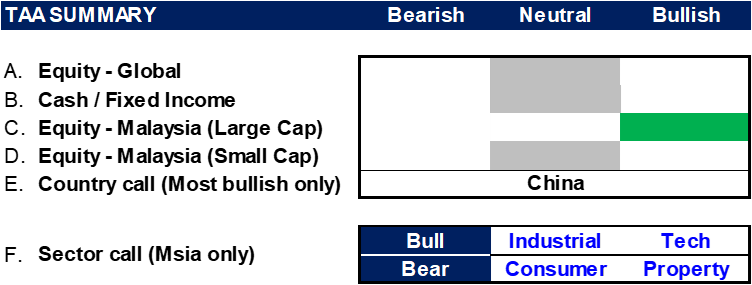
In Malaysia, we continue to like large-cap stocks and remain bullish on selected small-cap stocks. Sector-wise, we favour the Construction sector, supported by project rollouts and data centre investments. Additionally, we favour the Technology sector, seeing indications of the semi down-cycle stabilising, along with companies poised to benefit from the current AI excitement. Conversely, we continue to hold our underweight stance in Telco and Plantation sectors.
Exhibit 2: PCM’s monthly strategy snapshot
Source: PCM, 31 August 2026
Phillip Capital Malaysia and our offerings
We reaffirm our belief that there are still opportunities in the market, and we maintain a discerning approach in choosing high-quality stocks for our portfolio. However, it is crucial to exercise caution and carefully select investment options to ensure the best risk-adjusted returns. By taking a vigilant and discerning approach, investors can potentially reap the benefits of the current market opportunities while minimising risks.
A noteworthy avenue for investors seeking diversification in their portfolio is through PhillipCapital Malaysia. PhillipCapital Malaysia offers multiple private mandate services managed by professional fund managers. By leveraging PhillipCapital Malaysia’s private mandate services, investors can enhance their resiliency, optimise portfolio performance, and navigate the complexities of the market with confidence.
We also offer both conventional and Shariah-compliant options to cater to the needs of all investors. For Malaysia’s mandates, we like:
1. PMART/PMA Dividend Enhanced and/or PMART/PMA Dividend Enhanced ESG
Our PMART Dividend Enhanced and PMA Dividend Enhanced is an income-driven portfolio focused on high dividend-yielding equities. We apply the Dog of the Dow approach, screen and select top market cap stocks to minimise risk and ensure consistent performance. The portfolio is an equal weighting portfolio which reduces concentration risk and provides similar exposure to all clients, both initially and after rebalancing. We offer both conventional and Shariah investment options to cater to the diverse needs of our investors. Click here to learn more. We recently also introduced PMART/PMA Dividend Enhanced ESG Mandate as we remain dedicated to investing in ESG stocks given their stronger valuation and profitability.
2. PMART/PMA ESG
Phillip Capital Malaysia offers discretionary portfolio that invests in stocks with high ESG ratings from the F4GBM and F4GBMS Indices, namely PMART and PMA ESG. There are both conventional and Shariah options available. To explore the companies in which both Conventional and Shariah ESG mandates invest, you can refer to the provided link.
3. PMART/PMA Blue Chip and Opportunity
Our Blue-Chip portfolios primarily allocate our investments towards companies with large market capitalisations, while the Opportunity portfolios predominantly invest in companies with smaller market capitalisations. We also offer both conventional and Shariah-compliant options to cater to the needs of all investors.
Please click on the link to learn more or email us at cse.my@phillipcapital.com.my if you require any further information.
Disclaimer
The information contained herein does not constitute an offer, invitation, or solicitation to invest in any product or service offered by Phillip Capital Management Sdn Bhd (“PCM”). No part of this document may be reproduced or circulated without prior written consent from PCM. This is not a unit trust or collective investment scheme and is not an obligation of, deposit in, or guaranteed by PCM. All investments carry risks, including the potential loss of principal.
Performance figures presented may reflect model portfolios and may differ from actual client accounts’ performance. Variations in individual clients’ portfolios against model portfolios and between one client’s portfolio to another can arise due to multiple factors, including (but not limited to) higher relative brokerage costs for smaller portfolios, timing of capital injections or withdrawals, timing of purchases and sales, and mandate change (e.g., Shariah vs. conventional). These differences may impact overall performance.
Past performance is not necessarily indicative of future returns. The value of investments may rise or fall, and returns are not guaranteed. PCM has not considered your investment objectives, financial situation, or particular needs. You are advised to consult a licensed financial adviser before making any investment decisions.
While all reasonable care has been taken to ensure the accuracy and completeness of the information contained herein, no representation or warranty is made, and no liability is accepted for any loss arising directly or indirectly from reliance on this material. This publication has not been reviewed by the Securities Commission Malaysia.