Green bonds have become a key financial tool in tackling global environmental challenges. With global temperatures projected to rise between 0.3°C and 4.8°C this century bringing higher sea levels world leaders have committed under the Paris Agreement to limit warming to below 2°C. This has driven growing investor interest in Environmental, Social and Governance (ESG) investing.
A green bond is a fixed-income instrument used to fund projects with clear environmental benefits. What sets it apart is that its proceeds are strictly allocated to initiatives such as renewable energy, energy efficiency, sustainable water management, and climate adaptation. This is increasingly important as countries seek alternative energy sources amid global energy constraints and geopolitical tensions.
Globally, green bonds have financed major infrastructure projects, including large-scale solar and wind developments in countries like China and India, helping reduce reliance on fossil fuels and lower environmental impact.
The rapid growth of data centres is creating new demand for sustainable financing. As digitalisation accelerates, electricity consumption by data centres is expected to reach around 600 terawatt-hours by 2026. Green bonds can help fund this expansion by supporting energy-efficient technologies and infrastructure.
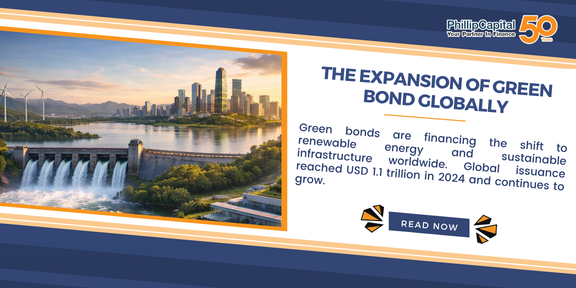
The sustainable bond market continues to grow. In 2024, total issuance reached USD 1.1 trillion, a 5% increase from 2023, with green bonds remaining the dominant segment (Exhibit 1). Despite macroeconomic and geopolitical uncertainties, issuance is expected to keep rising into 2026 (Exhibit 2).
Exhibit 1: Global Labelled Sustainable Bond Annual Issuance, USD Bn
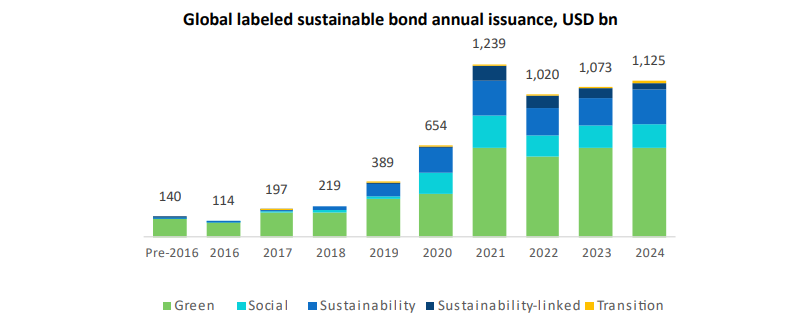
Source: World Bank based on data from Bloomberg, 7 April 2026
Exhibit 2: Issuance of Sustainability Debt
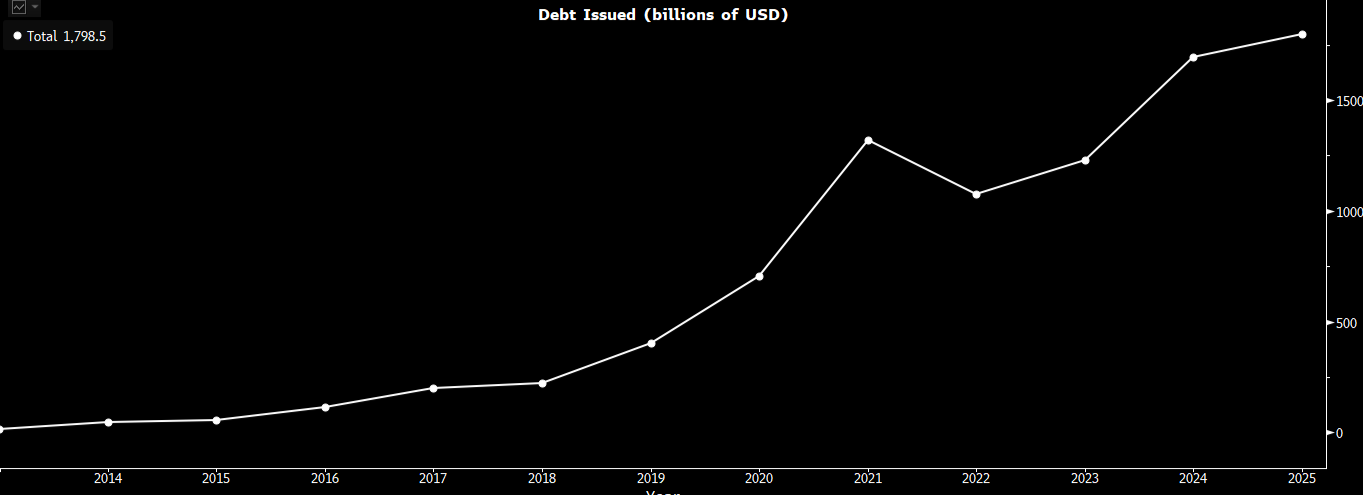
Source: Bloomberg, PCM, 7 April 2026
Beyond environmental impact, green bonds offer clear benefits. Issuers gain access to a growing pool of ESG-focused investors and may enjoy a lower cost of capital due to strong demand. Investors, in turn, can earn returns while supporting sustainability goals, along with potential diversification benefits and typically lower volatility compared to conventional bonds.
Our View:
Ongoing geopolitical tensions, particularly in the Middle East, have reinforced the urgency of transitioning to alternative energy. As global energy markets remain volatile, demand for alternative fuels is expected to stay strong. This period of uncertainty could ultimately accelerate the shift toward a more secure, sustainable, and diversified global energy system.
Disclaimer
The information contained herein does not constitute an offer, invitation, or solicitation to invest in any product or service offered by Phillip Capital Management Sdn Bhd (“PCM”). No part of this document may be reproduced or circulated without prior written consent from PCM. This is not a unit trust or collective investment scheme and is not an obligation of, deposit in, or guaranteed by PCM. All investments carry risks, including the potential loss of principal.
Performance figures presented may reflect model portfolios and may differ from actual client accounts’ performance. Variations in individual clients’ portfolios against model portfolios and between one client’s portfolio to another can arise due to multiple factors, including (but not limited to) higher relative brokerage costs for smaller portfolios, timing of capital injections or withdrawals, timing of purchases and sales, and mandate change (e.g., Shariah vs. conventional). These differences may impact overall performance.
Past performance is not necessarily indicative of future returns. The value of investments may rise or fall, and returns are not guaranteed. PCM has not considered your investment objectives, financial situation, or particular needs. You are advised to consult a licensed financial adviser before making any investment decisions.
While all reasonable care has been taken to ensure the accuracy and completeness of the information contained herein, no representation or warranty is made, and no liability is accepted for any loss arising directly or indirectly from reliance on this material. This publication has not been reviewed by the Securities Commission Malaysia.