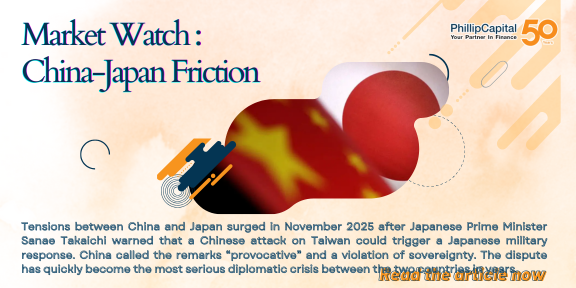
Tensions between China and Japan surged in November 2025 after Japanese Prime Minister Sanae Takaichi warned that a Chinese attack on Taiwan could trigger a Japanese military response. China called the remarks “provocative” and a violation of sovereignty. The dispute has quickly become the most serious diplomatic crisis between the two countries in years.
Maritime confrontations intensified around the Senkaku/Diaoyu Islands, with at least five Chinese coast guard vessels entering waters administered by Japan. Japanese Defense Minister Shinjiro Koizumi announced plans to deploy a medium-range missile battery on Yonaguni Island, 110 km from Taiwan, to deter potential aggression (in which China condemned it). Chinese military drones were observed near Japan’s southern islands, raising the risk of escalation.
Economic fallout is significant. China, Japan’s second-largest export market, imports roughly $125 billion in Japanese goods annually. Following the spat, China banned all Japanese seafood imports, reversing partial easing measures from earlier in 2025. Chinese tourism to Japan, which accounted for nearly 7.5 million visitors in the first nine months of 2025 (roughly 25% of all foreign arrivals), has plunged as airlines offered mass refunds. Analysts estimate $1–2 billion in lost tourism revenue so far. Cultural exchanges, including Japanese concerts and film releases, were also suspended.
On a separate note, international reactions have been swift. The U.S. reaffirmed its support for Japan, while Taiwan condemned China’s UN letter calling Japanese intervention a “threat.” Regional analysts warn the standoff may persist, with military assets on alert across the East China Sea and the Taiwan Strait.
Investors and businesses now face uncertainty: Japan’s fishing exports risk losing over 20% of their market, while tourism and retail revenues have already fallen sharply. Meanwhile, Japan’s defense spending and deployment plans may indicate a long-term strategic recalibration, signaling continued friction within the region. As a result, several major Asian markets have corrected from their 52-week highs amid rising geopolitical tensions and risk aversion. However, as of the time of writing, markets have already recouped part of those losses, suggesting investors are selectively buying on dips while monitoring further developments.
Our views on Asia market remain cautiously optimistic. We believe improved liquidity from the Fed rate cut could offer some tailwinds, though global growth and policy uncertainties may weigh on sentiment. We maintain a barbell strategy through 2025, combining quality growth opportunities with defensive income assets to navigate potential volatility.
Disclaimer
The information contained herein does not constitute an offer, invitation, or solicitation to invest in any product or service offered by Phillip Capital Management Sdn Bhd (“PCM”). No part of this document may be reproduced or circulated without prior written consent from PCM. This is not a unit trust or collective investment scheme and is not an obligation of, deposit in, or guaranteed by PCM. All investments carry risks, including the potential loss of principal.
Performance figures presented may reflect model portfolios and may differ from actual client accounts’ performance. Variations in individual clients’ portfolios against model portfolios and between one client’s portfolio to another can arise due to multiple factors, including (but not limited to) higher relative brokerage costs for smaller portfolios, timing of capital injections or withdrawals, timing of purchases and sales, and mandate change (e.g., Shariah vs. conventional). These differences may impact overall performance.
Past performance is not necessarily indicative of future returns. The value of investments may rise or fall, and returns are not guaranteed. PCM has not considered your investment objectives, financial situation, or particular needs. You are advised to consult a licensed financial adviser before making any investment decisions.
While all reasonable care has been taken to ensure the accuracy and completeness of the information contained herein, no representation or warranty is made, and no liability is accepted for any loss arising directly or indirectly from reliance on this material. This publication has not been reviewed by the Securities Commission Malaysia.