
The MSCI Asia Pacific Ex-Japan Index (-6.9%) underperformed the MSCI World Index (-0.8%) in October, as renewed concerns over debt-funded AI spending triggered a broad-based technology selloff. India (+1.9%) led regional equity markets, followed by the Philippines, which closed flat (0.0%). Among the other Southeast Asian markets, Malaysia (-2.2%) and Thailand (-2.6%) recorded relatively modest declines. Elsewhere, Japan (-5.2%), Singapore (-5.3%), Hong Kong (-5.4%), Taiwan (-5.7%), China (-8.5%) and Indonesia (-16.7%) declined the most. South Korea (-16.2%) also suffered a sharp correction, trimming its year-to-date gain to 36.0%. Globally, Europe (STOXX 600: +1.9%) and the Dow Jones (+1.7%) advanced, while the Nasdaq (-4.7%) and S&P 500 (-0.9%) declined amid disappointing technology earnings. All in, October’s market weakness reflected a broad reassessment of AI-related investment expectations, with technology-heavy markets bearing the brunt of the selloff. Elevated oil prices, hawkish Fed expectations and persistent capital-flow pressures further weighed on regional risk appetite.
Regional central banks maintained a cautious stance amid elevated energy prices, inflationary pressures and uncertainty over the global interest-rate outlook. The Bank of Japan (BOJ) kept its short-term policy rate unchanged at 1.25% at its end-October meeting, while maintaining the possibility of further policy tightening as inflation approaches its target.
Exhibit 1: Market Performance October 2026
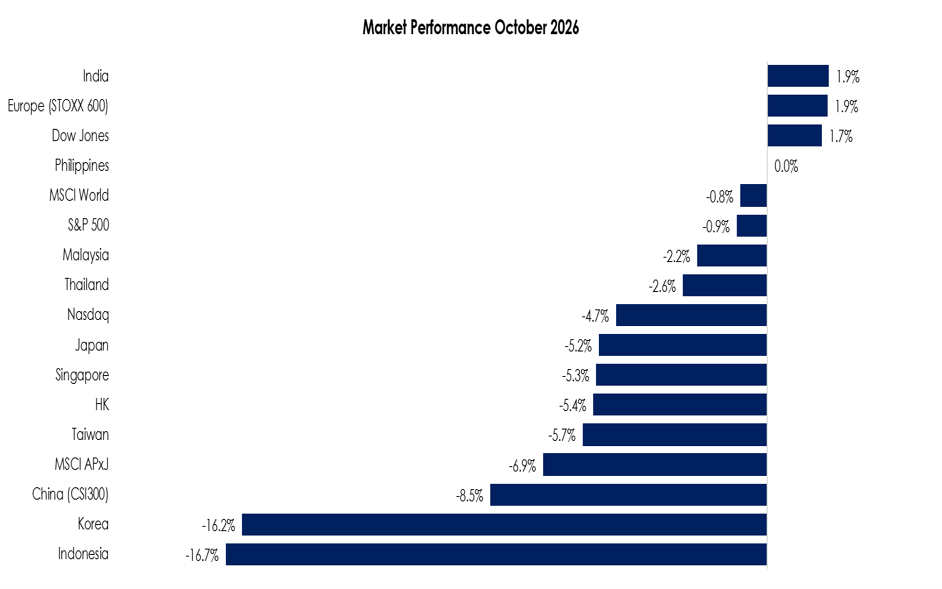
Source: Bloomberg, PCM, 31 October 2026
The MSCI World Index declined 0.8% in October, as weakness in large US technology companies outweighed gains across several other sectors. Global sentiment was pressured by growing scrutiny over the scale of AI infrastructure investment and whether the substantial capital committed would generate sufficient returns, while higher financing costs added pressure on technology-related companies. In the United States, market performance diverged significantly. The Dow Jones gained 1.7%, while the S&P 500 (-0.9%) and Nasdaq (-4.7%) declined, with the technology-heavy Nasdaq bearing the brunt of the late-month correction. Investor concerns increasingly shifted from the pace of AI investment towards the returns generated from elevated capital expenditure, prompting renewed volatility across AI- and semiconductor-related stocks. Meanwhile, Europe rose 1.9%, outperforming the broader developed market despite continued concerns surrounding energy prices and economic growth.
The FBM KLCI declined 2.2% MoM to 1,615.6 points in October 2026, outperforming most regional markets despite net selling by foreign and local institutional investors and heightened global risk aversion. Healthcare (+6.3%) was the best-performing domestic sector, while plantations (-5.4%) and construction (-4.8%) lagged. Foreign investors remained net sellers for the third consecutive month, although net outflows narrowed to RM874m from RM1.62bn in September 2026, bringing cumulative 10M26 outflows to RM7.33bn. Foreign buying resumed in the final week, helping the KLCI recover from its intra-month low of 1,595.75 points.
Among KLCI constituents, 10 stocks gained while 20 declined in October 2026. The top gainers were Petronas Chemicals (+12.4%), MISC (+8.0%) and Nestlé (+6.6%), while CIMB (-11.3%), YTL Power (-10.0%) and Hong Leong Bank (-8.6%) were the largest decliners.
In the commodities market, WTI crude oil rose 11.9% MoM to US$104.1/bbl, while Brent crude gained 15.1% MoM to US$117.2/bbl in October. Crude palm oil (CPO) prices increased 1.5% MoM to RM4,681/MT, while spot gold declined 6.9% MoM to US$3,875/oz. In the currency market, the Malaysian ringgit depreciated 0.5% MoM against the US dollar to RM4.05/US$, while the US Dollar Index (DXY) fell 0.5% to 101.9.
Budget 2027, tabled on 9 October, targets a narrower fiscal deficit of 3.3% of GDP in 2027 (2026F: 3.6%) and includes higher personal income tax relief, RM83bn in development expenditure and a 17.6% increase in the minimum wage to RM2,000, effective June 2027. Globally, the US Federal Reserve (Fed) held interest rates at 3.75–4.00% on 28 October amid persistent inflation, reinforcing expectations of further tightening. The upcoming US midterm elections, escalating Middle East tensions and Brent crude prices above US$115 per barrel added to market uncertainty.
Equity Market Outlook & Investment Strategy
MALAYSIA
Malaysia’s macroeconomic backdrop remained resilient in October, supported by manageable inflation, improving manufacturing activity and sustained domestic investment momentum. Headline inflation moderated to 1.8% year-on-year in September 2026 (August: 1.9%), with softer increases in housing and utilities, food and beverages, and information and communication partly offset by firmer transport inflation. Higher crude oil prices during the month, with Brent crude oil rising 13.6% m-o-m to US$117.6 per barrel, provided a supportive backdrop for the domestic oil and gas sector, although the sharp increase in energy prices also raised concerns over input costs and broader inflationary pressures. Meanwhile, crude palm oil prices remained relatively stable at around RM4,449/MT, increasing marginally by 0.6% m-o-m.
Manufacturing conditions improved notably, with the S&P Global Malaysia Manufacturing PMI rising to 51.0 in October from 49.9 in September, returning to expansion territory as new orders and output recovered, supported partly by stronger demand for AI-related products. Meanwhile, the FBMKLCI declined 2.2% m-o-m to 1,615.60 points in October, reflecting the broader deterioration in regional risk sentiment. Overall, Malaysia’s economic fundamentals remained relatively resilient, underpinned by improving manufacturing demand and continued domestic activity, although higher energy and input costs, persistent external uncertainties and weaker global risk sentiment remain key factors to monitor heading into the final quarter of 2026.
REGIONAL / GLOBAL
Regional and global markets weakened in October, with the sell-off more pronounced across Asia as concerns over elevated AI-related capital expenditure, higher financing costs and the sustainability of returns from technology investment weighed on sentiment. Technology- and semiconductor-heavy markets experienced the sharpest correction, while developed markets proved relatively more resilient as gains outside the technology sector helped cushion broader weakness. Despite the market volatility, underlying global economic activity remained relatively resilient, although higher energy prices, geopolitical uncertainty and tighter financial conditions continued to cloud the near-term outlook.
Against this backdrop, we remain selective, favouring high-quality companies with resilient earnings, strong balance sheets and sustainable cash flows, while maintaining selective exposure to long-term structural themes such as AI and digital infrastructure. A balanced allocation between structural growth and income-generating assets remains appropriate amid heightened market volatility.
Fixed Income Outlook & Strategy
MALAYSIA
Malaysian government bond yields are likely to trade within a broad range, underpinned by moderate consumer inflation, steady domestic institutional demand and continued fiscal consolidation. However, rising producer prices and elevated energy costs pose upside risks to consumer inflation, keeping potential BNM policy normalisation in focus. We expect the OPR to remain at 2.75% in November, followed by a possible 25-basis-point increase in 1Q2027. Volatile foreign flows, elevated UST yields and geopolitical uncertainty could weigh on sentiment, while upcoming government bond supply may exert temporary pressure on longer-dated yields. Against this backdrop, we favour a selective duration strategy, retaining shorter-dated securities for flexibility while seeking yield enhancement through high-quality corporate bonds and sukuk. Any increase in yields may provide opportunities to extend duration selectively, guided by attractive valuations, adequate liquidity and signs of stabilising inflation pressures.
REGIONAL
US Treasuries rallied during October as safe-haven demand, softer consumer confidence and volatility in technology-related assets outweighed persistent inflation and resilient economic activity. As at 30 October, the 10-year UST yield had declined by 34.8 basis points from 5.285% at end-September to 4.937%, while the 2-year yield fell by 28.9 basis points to 4.598% and the 30-year yield declined by 32.9 basis points to 5.300%. At its October meeting, the Federal Reserve maintained the federal funds target range at 3.75%–4.00%, following September’s 25-basis-point increase. The October decision was supported by a 10–2 vote, with two members favouring a further increase. The Fed continued to highlight elevated inflation and provided no firm commitment on December policy. US headline PCE inflation rose to 3.6% year-on-year in September from 3.4% in August, while core PCE inflation increased to 3.1%. Meanwhile, 3Q2026 GDP expanded by a stronger-than-expected 3.4% on an annualised quarterly basis, compared with 2.2% in 2Q2026, keeping expectations of further tightening intact.
UST yields are expected to remain volatile as markets balance safe-haven demand against persistent inflation, resilient growth and the possibility of another Fed rate increase. We expect a 25-basis-point increase in December and projects the 10-year UST yield at 5.00% at the end of 2026. These expectations remain sensitive to upcoming employment and inflation releases. Middle East tensions and elevated oil prices pose upside risks to inflation expectations and longer-dated yields, while fiscal financing requirements could sustain a higher term premium. Conversely, weaker economic data, further equity market volatility or geopolitical de-escalation could support Treasury demand. Against this backdrop, a sustained decline in yields would require clearer evidence of easing inflation or moderating economic momentum.
Elsewhere, the European Central Bank kept its policy rates unchanged during the review period. Political and fiscal uncertainty in France weighed on European sentiment, while expectations of further Bank of England tightening continued to influence sterling and UK bond markets. Regional fixed income markets remained sensitive to US rate expectations, global energy prices and currency movements.
Strategy for the month
Limited progress towards de-escalating geopolitical tensions in the Middle East, alongside elevated bond yields, continue to limit the scope for multiple expansion across global equity markets. On a further scrutiny, higher energy prices, widening fiscal deficits and heavy AI-related debt issuance have collectively exerted upward pressure on government bond yields globally. Bloomberg Global Treasuries Index topped 4% for the first time since 2007, while long-dated U.S. Treasury yields reached their highest level since 2002. That said, we maintain a neutral stance on global equities, but we do not discount the likelihood that US equities may lead the recovery, should stronger-than-anticipated corporate earnings and upbeat management guidance provide some cushion against the prevailing risk-off sentiment.
Closer to home, we see a shift away from the crowded data-centre theme towards more defensive sectors, particularly Plantations and Banking. We believe Malaysia’s palm oil output has peaked for 2026, alongside inventory levels. From here, we expect stockpiles to gradually decline in November before falling at a faster pace from December onwards, particularly during the seasonally low production quarter of 1Q27. Separately, loan growth is expected to remain robust, propelled by Malaysia’s investment upcycle, while the sectors’ healthy dividend payouts could provide some cushion against global risk-off sentiment. As such, we remain positive on large-cap equities, which should be among the key beneficiaries of the robust domestic investment upcycle. Conversely, we remain underweight Technology and Industrials, reflecting elevated valuations following the recent technology sector rally.
Exhibit 2: PCM’s monthly strategy snapshot
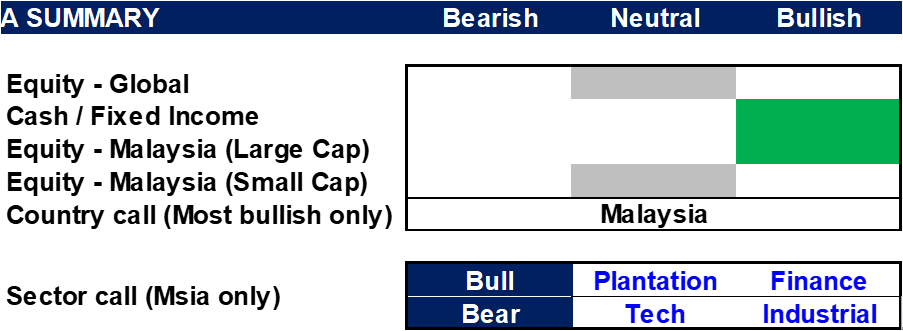
Source: PCM, 31 October 2026
Phillip Capital Malaysia and our offerings
We reaffirm our belief that there are still opportunities in the market, and we maintain a discerning approach in choosing high-quality stocks for our portfolio. However, it is crucial to exercise caution and carefully select investment options to ensure the best risk-adjusted returns. By taking a vigilant and discerning approach, investors can potentially reap the benefits of the current market opportunities while minimising risks.
A noteworthy avenue for investors seeking diversification in their portfolio is through PhillipCapital Malaysia. PhillipCapital Malaysia offers multiple private mandate services managed by professional fund managers. By leveraging PhillipCapital Malaysia’s private mandate services, investors can enhance their resiliency, optimise portfolio performance, and navigate the complexities of the market with confidence.
We also offer both conventional and Shariah-compliant options to cater to the needs of all investors. For Malaysia’s mandates, we like:
1. PMART/PMA Dividend Enhanced and/or PMART/PMA Dividend Enhanced ESG
Our PMART Dividend Enhanced and PMA Dividend Enhanced is an income-driven portfolio focused on high dividend-yielding equities. We apply the Dog of the Dow approach, screen and select top market cap stocks to minimise risk and ensure consistent performance. The portfolio is an equal weighting portfolio which reduces concentration risk and provides similar exposure to all clients, both initially and after rebalancing. We offer both conventional and Shariah investment options to cater to the diverse needs of our investors. Click here to learn more. We recently also introduced PMART/PMA Dividend Enhanced ESG Mandate as we remain dedicated to investing in ESG stocks given their stronger valuation and profitability.
2. PMART/PMA ESG
Phillip Capital Malaysia offers discretionary portfolio that invests in stocks with high ESG ratings from the F4GBM and F4GBMS Indices, namely PMART and PMA ESG. There are both conventional and Shariah options available. To explore the companies in which both Conventional and Shariah ESG mandates invest, you can refer to the provided link.
3. PMART/PMA Blue Chip and Opportunity
Our Blue-Chip portfolios primarily allocate our investments towards companies with large market capitalisations, while the Opportunity portfolios predominantly invest in companies with smaller market capitalisations. We also offer both conventional and Shariah-compliant options to cater to the needs of all investors.
Please click on the link to learn more or email us at cse.my@phillipcapital.com.my if you require any further information.
Disclaimer
The information contained herein does not constitute an offer, invitation, or solicitation to invest in any product or service offered by Phillip Capital Management Sdn Bhd (“PCM”). No part of this document may be reproduced or circulated without prior written consent from PCM. This is not a unit trust or collective investment scheme and is not an obligation of, deposit in, or guaranteed by PCM. All investments carry risks, including the potential loss of principal.
Performance figures presented may reflect model portfolios and may differ from actual client accounts’ performance. Variations in individual clients’ portfolios against model portfolios and between one client’s portfolio to another can arise due to multiple factors, including (but not limited to) higher relative brokerage costs for smaller portfolios, timing of capital injections or withdrawals, timing of purchases and sales, and mandate change (e.g., Shariah vs. conventional). These differences may impact overall performance.
Past performance is not necessarily indicative of future returns. The value of investments may rise or fall, and returns are not guaranteed. PCM has not considered your investment objectives, financial situation, or particular needs. You are advised to consult a licensed financial adviser before making any investment decisions.
While all reasonable care has been taken to ensure the accuracy and completeness of the information contained herein, no representation or warranty is made, and no liability is accepted for any loss arising directly or indirectly from reliance on this material. This publication has not been reviewed by the Securities Commission Malaysia.