
Malaysia’s biodiesel programme offers a way to strengthen domestic palm oil demand while reducing reliance on petroleum diesel. Most road transport currently uses B10 diesel, which contains 10% palm-based biodiesel, while B20 has been implemented in Labuan, Langkawi and most parts of Sarawak. The government intends to expand blending gradually towards B20 and eventually B30, subject to infrastructure readiness, fiscal capacity and market conditions.
Higher blending would replace a larger share of conventional diesel with palm-based fuel produced locally. This would provide an additional buffer during periods of volatile crude oil prices, geopolitical tension or disruptions to major energy supply routes. The policy also creates greater domestic value from Malaysia’s palm oil production by directing part of the country’s output towards transport fuel rather than relying mainly on export markets.
Biodiesel will not provide full energy independence because petroleum diesel will remain the largest component of blended fuel. Its strategic value lies in reducing the amount of fossil diesel required for domestic consumption and extending available fuel supplies during external disruptions. Malaysia already has an established supply chain covering plantations, mills, refineries and biodiesel plants, giving the country both the feedstock and production base needed to support higher blending.
Exhibit 1: Malaysia Has Capacity, but Not Nationwide Readiness
Source: PCM, 23 July 2026
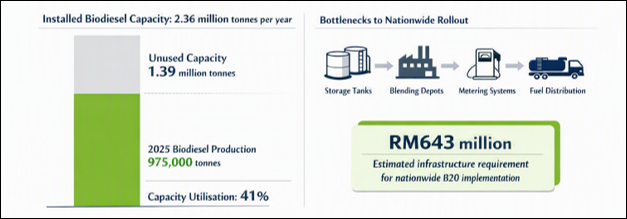
Exhibit 1 shows that Malaysia’s main biodiesel constraint is not production capacity. The country produced about 975,000 tonnes of biodiesel in 2025, equal to only 41% of its installed annual capacity of 2.36 million tonnes. This leaves around 1.39 million tonnes of unused capacity across existing facilities. Current plants therefore have sufficient room to raise production as blending requirements increase, reducing the need for a major new manufacturing cycle before B20 or B30 adoption expands.
The right side of Exhibit 1 identifies the more immediate bottleneck: storage tanks, blending depots, metering systems and fuel distribution facilities. Nationwide B20 implementation was previously estimated to require about RM643 million in infrastructure spending. A phased rollout allows the government to upgrade strategic depots in Sandakan, Tawau, Sepanggar and Bintulu, monitor operational performance and spread expenditure over several years. The timing of these upgrades will determine how quickly unused production capacity translates into higher domestic biodiesel consumption.
Higher biodiesel blending would create a more stable source of local palm oil demand. A shift from B10 to B20 doubles the palm-based content used in each litre of blended diesel, while a later move to B30 would increase the requirement further. Wider adoption is estimated to add more than 300,000 tonnes to annual biodiesel demand, supporting plant utilisation and reducing part of the plantation sector’s dependence on external markets.
The impact will differ across the palm oil value chain. Integrated plantation groups with biodiesel facilities have the clearest exposure because they benefit from stronger feedstock demand and higher utilisation of downstream assets. Upstream plantation companies receive an indirect benefit through firmer domestic CPO demand. Standalone biodiesel processors gain from higher production volumes, but their margins remain sensitive to the relationship between CPO prices and petroleum diesel prices.
Exhibit 2: When Does Biodiesel Become Economically Attractive?
Source: Ministry of Plantation and Commodities, PCM, 23 July 2026
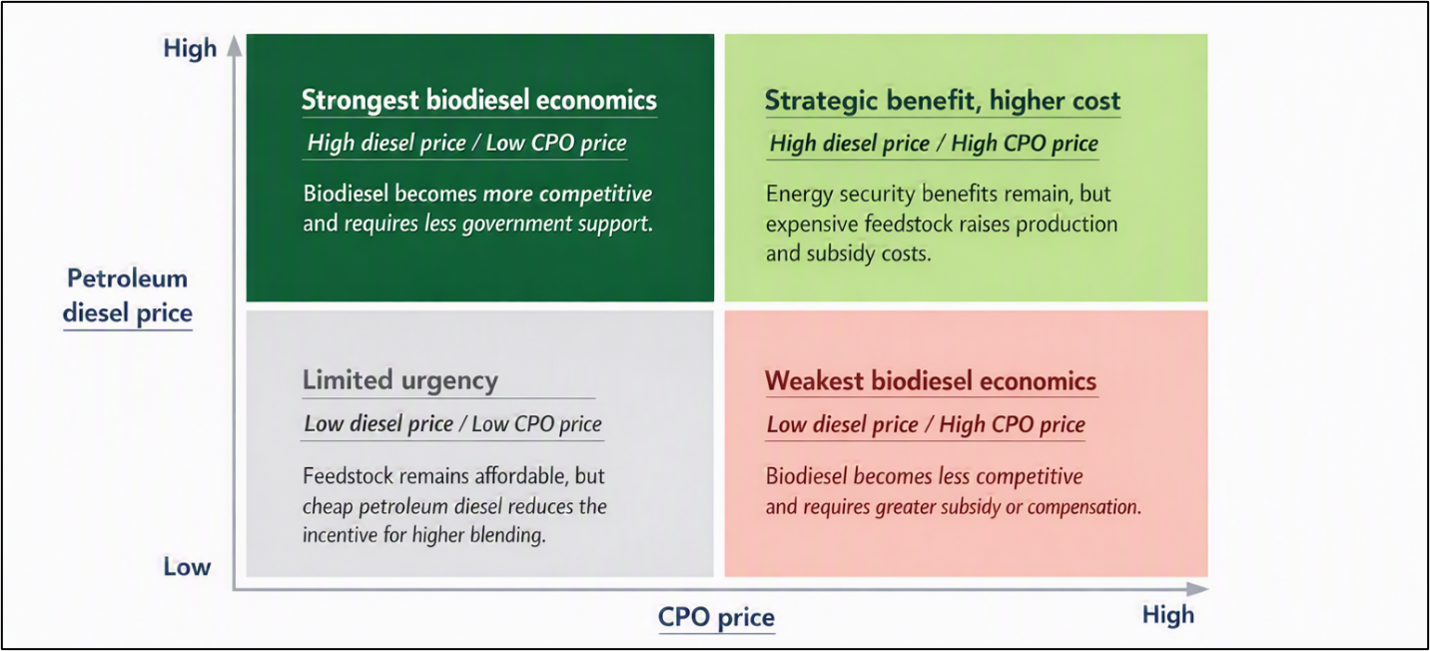
Exhibit 2 shows that biodiesel is most competitive when petroleum diesel prices are high and CPO prices remain low, as the cost gap narrows and less subsidy is required. The weakest economics occur when CPO prices are high while diesel prices remain low, since feedstock costs rise without a matching increase in conventional fuel prices. When both prices move in the same direction, the outcome is more balanced. The CPO-diesel price spread therefore remains the key factor shaping government support, rollout timing and producer profitability.
For investors, B20 and B30 provide medium-term structural support for domestic palm oil demand, but policy targets alone will not produce an immediate earnings uplift. The outcome will depend on infrastructure completion, the CPO-diesel price spread, subsidy arrangements and actual regional implementation. Integrated plantation groups with biodiesel operations have the most direct exposure, while execution will determine whether Malaysia converts its unused production capacity into lasting support for energy security and plantation-sector earnings.
Disclaimer
The information contained herein does not constitute an offer, invitation, or solicitation to invest in any product or service offered by Phillip Capital Management Sdn Bhd (“PCM”). No part of this document may be reproduced or circulated without prior written consent from PCM. This is not a unit trust or collective investment scheme and is not an obligation of, deposit in, or guaranteed by PCM. All investments carry risks, including the potential loss of principal.
Performance figures presented may reflect model portfolios and may differ from actual client accounts’ performance. Variations in individual clients’ portfolios against model portfolios and between one client’s portfolio to another can arise due to multiple factors, including (but not limited to) higher relative brokerage costs for smaller portfolios, timing of capital injections or withdrawals, timing of purchases and sales, and mandate change (e.g., Shariah vs. conventional). These differences may impact overall performance.
Past performance is not necessarily indicative of future returns. The value of investments may rise or fall, and returns are not guaranteed. PCM has not considered your investment objectives, financial situation, or particular needs. You are advised to consult a licensed financial adviser before making any investment decisions.
While all reasonable care has been taken to ensure the accuracy and completeness of the information contained herein, no representation or warranty is made, and no liability is accepted for any loss arising directly or indirectly from reliance on this material. This publication has not been reviewed by the Securities Commission Malaysia.