
Bear markets are never comfortable. When markets fall, the screen turns red, headlines turn negative and portfolio values decline. It is normal to feel uneasy. A common reaction is to step aside, hold cash and wait until things look safer. The challenge is that markets rarely give a clear signal before they recover. By the time the news feels better, prices may have already moved higher. This is why long-term investing is less about predicting every market bottom and more about staying disciplined through different market cycles.
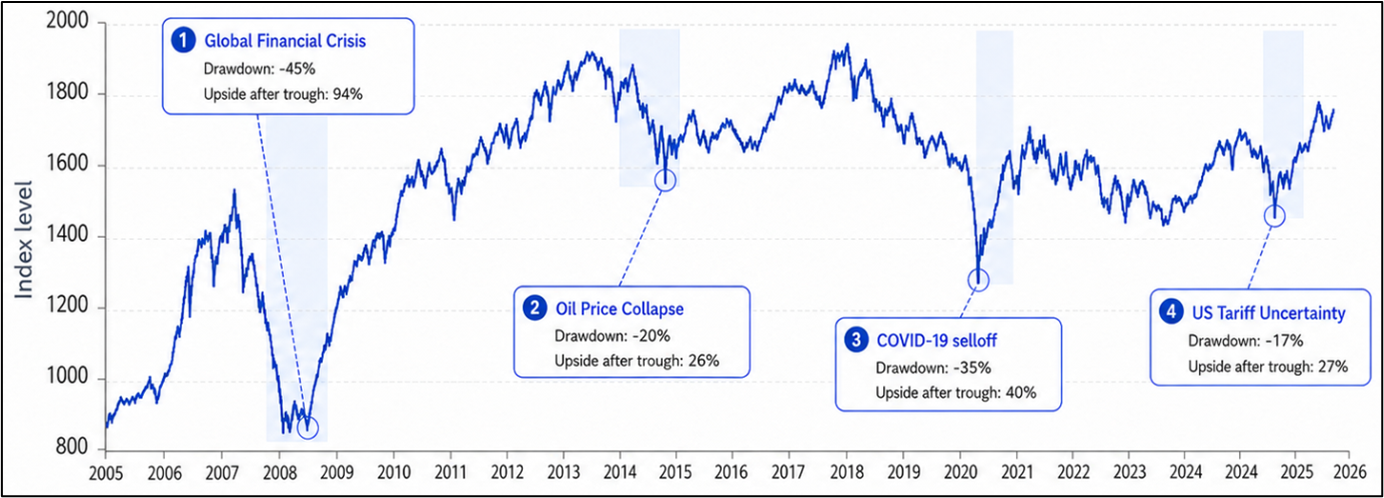
For Malaysia, the FBM KLCI is a useful reference point. The index tracks 30 of the largest eligible companies listed on Bursa Malaysia’s Main Market and is widely used as the key benchmark for the local equity market. Over the past 20 years, the market has gone through several difficult periods, including the Global Financial Crisis, the oil price collapse, the COVID-19 selloff and more recently, tariff-related uncertainty. The path was not smooth, but the bigger picture shows why staying invested matters.
Exhibit 1: FBM KLCI 20-year chart with drawdowns and recoveries
Source: Bloomberg, PCM, 8 May 2026
Exhibit 1 highlights an important point. Market declines are part of the journey. The Global Financial Crisis saw a sharp drawdown, followed by a strong recovery. The oil price collapse created pressure on the Malaysian market and ringgit sentiment, but the market later recovered from its trough. COVID-19 caused a fast selloff, yet the rebound also came quickly. The 2025 tariff uncertainty created another pullback, but it was still part of a wider market cycle.
A simple way to look at it is this: the market may have a bad season without having a bad future. During a downturn, the focus is usually on the fall. But the recovery after the fall matters just as much. A portfolio that remains invested through the difficult period remains positioned to participate in the rebound. A portfolio that exits during fear faces a second problem: deciding when to re-enter.
That decision is difficult because recovery often begins before confidence returns. This does not mean every falling asset is worth holding. Some companies fall because their fundamentals weaken. Some face lower earnings, higher debt, poor cash flow or structural business challenges. Staying invested does not mean ignoring risk. It means avoiding panic decisions and focusing on quality, valuation, diversification, income potential and the original investment objective.
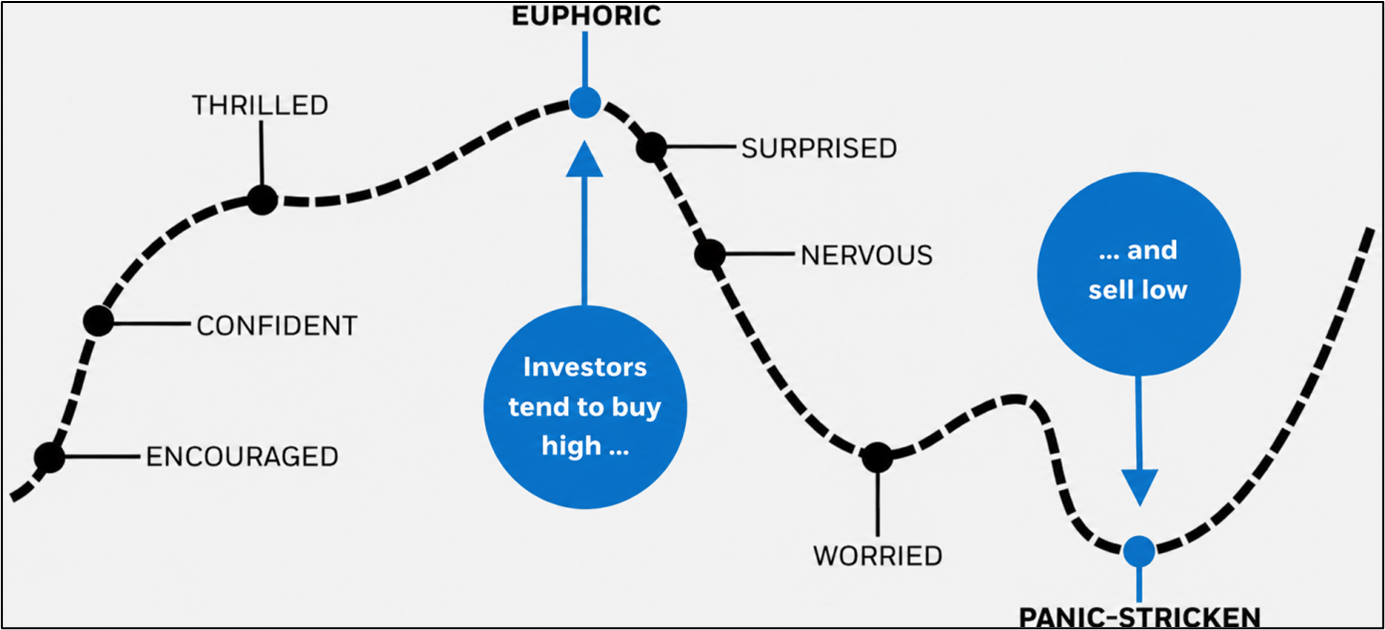
Bear markets also create emotional pressure. As prices rise, confidence builds and can turn into excitement, making people more willing to buy. When prices fall sharply, confidence weakens and fear increases, often leading people to sell at the worst time. This emotional cycle is what often causes the classic mistake of buying high and selling low.
Exhibit 2: Emotional investment cycle, buy high and sell low
Source: PCM, 8 May 2026
Market cycles influence behaviour. When prices are high, confidence may lead to buying. When prices are low, fear may lead to selling. A disciplined long-term plan helps reduce emotional decision-making.
Exhibit 2 highlights the importance of discipline and patience during market cycles. The market tests both returns and behaviour, as strong sentiment can make risk feel low, while weak sentiment can make risk feel high. In reality, the opportunity may be the opposite. High prices may already reflect optimism, while low prices may already reflect fear. This is why long-term investing is not about avoiding every decline, but having a process that can survive different market conditions. Corrections, drawdowns and bear markets are normal, and what matters is how one responds.
A better approach is to pause and review the portfolio objectively. For Malaysia, dividends are an important part of the return experience, especially during market weakness when dividend income can help support total return. Reinvested dividends also allow compounding to work over time. Beyond dividends, sector selection matters. For example, in Malaysia, data centres may benefit from renewable energy growth, as data centres require reliable power and cleaner energy sources to support long-term operations. This shows why earnings visibility, cash flow stability and long-term structural demand matter.
There will be strong years, weak years and periods where the market feels like it is going nowhere. But for those who stay diversified, selective and patient, bear markets are part of the long-term journey. Malaysia’s MY Value Up programme, introduced by the Securities Commission Malaysia and Bursa Malaysia under the Capital Market Masterplan 2026-2030, aims to encourage public-listed companies to better communicate their medium- to long-term strategies, improve transparency and strengthen investor engagement. Over time, these efforts could support better price discovery, stronger corporate value creation and improved market confidence, reinforcing the importance of viewing short-term market weakness within a longer-term context.
For those with available cash and a suitable risk profile, downturns do not need to be approached all at once. Instead of trying to guess the lowest point, the money can be invested slowly in smaller amounts. This means some buying may happen at higher prices, and some may happen at lower prices. Over time, this helps reduce the risk of making one large investment at the wrong time. The key message is simple: do not let a bear market turn a long-term plan into a short-term reaction.
Disclaimer
The information contained herein does not constitute an offer, invitation, or solicitation to invest in any product or service offered by Phillip Capital Management Sdn Bhd (“PCM”). No part of this document may be reproduced or circulated without prior written consent from PCM. This is not a unit trust or collective investment scheme and is not an obligation of, deposit in, or guaranteed by PCM. All investments carry risks, including the potential loss of principal.
Performance figures presented may reflect model portfolios and may differ from actual client accounts’ performance. Variations in individual clients’ portfolios against model portfolios and between one client’s portfolio to another can arise due to multiple factors, including (but not limited to) higher relative brokerage costs for smaller portfolios, timing of capital injections or withdrawals, timing of purchases and sales, and mandate change (e.g., Shariah vs. conventional). These differences may impact overall performance.
Past performance is not necessarily indicative of future returns. The value of investments may rise or fall, and returns are not guaranteed. PCM has not considered your investment objectives, financial situation, or particular needs. You are advised to consult a licensed financial adviser before making any investment decisions.
While all reasonable care has been taken to ensure the accuracy and completeness of the information contained herein, no representation or warranty is made, and no liability is accepted for any loss arising directly or indirectly from reliance on this material. This publication has not been reviewed by the Securities Commission Malaysia.