Introduction
Open your investment app. A flashing red number sits beside your portfolio. In an instant, logic flies out the window, and your finger hovers over the “switch” button. Today, investors can move capital with a few clicks and scrutinize fund performance by the minute. While this convenience offers unprecedented control, it can also turn short-term market noise into immediate panic. This article tackles the ultimate investor dilemma: should you buy and hold, or try to time the market? The answer is rarely as simple as “hold forever” or “switch constantly.” Instead, success lies in knowing when patience is a discipline and when it becomes neglect.
What are Mutual Funds?
A mutual fund is an investment vehicle that pools money from many investors to buy a diversified portfolio of securities such as stocks, bonds, and other assets. For example, instead of one investor buying shares in several Malaysian companies on their own, a mutual fund allows many investors to invest together in one professionally managed portfolio. It is managed by finance professionals who make investment decisions on behalf of investors. For Malaysian equity funds, the goal is often to perform better than the market benchmark.
The Big Debate: Buy and Hold vs Timing the Market
“Buy and hold” means giving an investment enough time to perform through market ups and downs. It does not mean ignoring problems or holding a weak fund forever. Investors should still review the fund, check whether the original investment reasons remain valid, and compare performance with a suitable benchmark. The difference is that decisions are based on evidence, not panic.
“Timing the market” means trying to sell before prices fall and buy back before prices rise. The challenge is that both decisions must be correct. During the Covid-19 sell-off in March 2020, many investors moved to cash because of fear. However, the FBM KLCI recovered before confidence fully returned, meaning those who waited for safer conditions may have missed part of the rebound.
The Covid-19 market shock showed why timing the market is difficult. When the Movement Control Order (MCO) caused sharp losses, selling felt like the safest choice. However, Bursa Malaysia later experienced a strong recovery, supported by liquidity, retail participation, and pandemic-related sectors. Investors who sold during the panic risked missing the recovery.
For mutual fund investors, the main decision is whether to switch or stay invested. Switching may be appropriate when a fund no longer matches the investor’s goals, risk level, or strategy. However, switching based only on last year’s performance can be risky, as market leaders can change. The better approach is to make decisions based on evidence rather than emotions.
What the FBM KLCI Data Shows
The FTSE Bursa Malaysia KLCI (FBM KLCI) is Malaysia’s main stock market index. It tracks the performance of 30 large companies listed on Bursa Malaysia’s Main Market. In simple terms, it shows how Malaysia’s biggest companies are performing and serves as a benchmark for investors. Malaysian equity funds often use the FBM KLCI to measure whether they are outperforming the local market over time.
The FBM KLCI is best understood through the events behind its movements. Political uncertainty, the US-China trade war, Covid-19, inflation, interest rates, currency pressure, and global tensions all shaped investor sentiment. Despite major downturns, the market recovered as confidence returned through retail participation, foreign investment, data-centre projects, semiconductor growth, and stronger blue-chip performance. The key lesson is that markets respond to changing conditions, making consistent market timing extremely difficult.
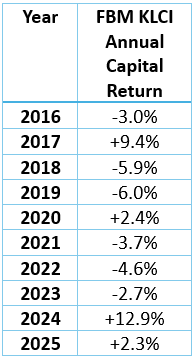
Source: FTSE Russell FBM KLCI factsheet, data as of 30 June 2026.
Past performance is not a guarantee of future results.
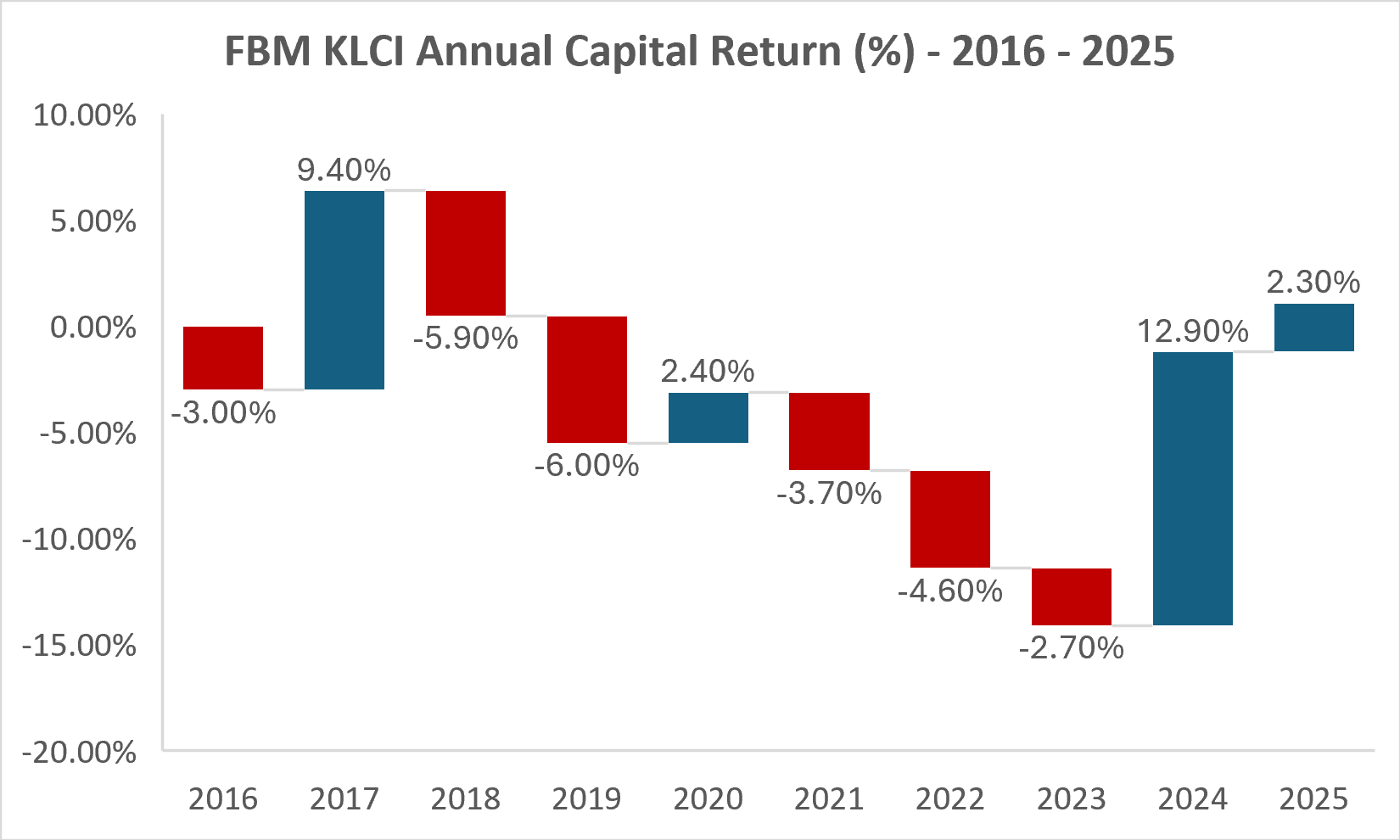
Figure 1: FBM KLCI annual capital returns from 2016 to 2025. The chart uses the same values shown in the table above. Blue bars show positive years, while red bars show negative years.
Why “Time in the Market” Matters
“Time in the market” means staying invested through good and bad periods. It is not blind loyalty. It is resisting the urge to sell only because recent numbers look ugly.
Research from Morningstar found that steady investing beat a timing-based approach over a 21-year model period, partly because the timing strategy spent too much time sitting in cash. Vanguard has also shown that markets often recover after painful periods. Hartford Funds found that many of the best market days happened during bear markets or early recoveries. In short: if investors leave during trouble, they may miss the snapback.
Some of this research is global or US-based, not Malaysia-specific. Still, the lesson travels well: recovery days are easy to see after they happen, but hard to catch before they begin.
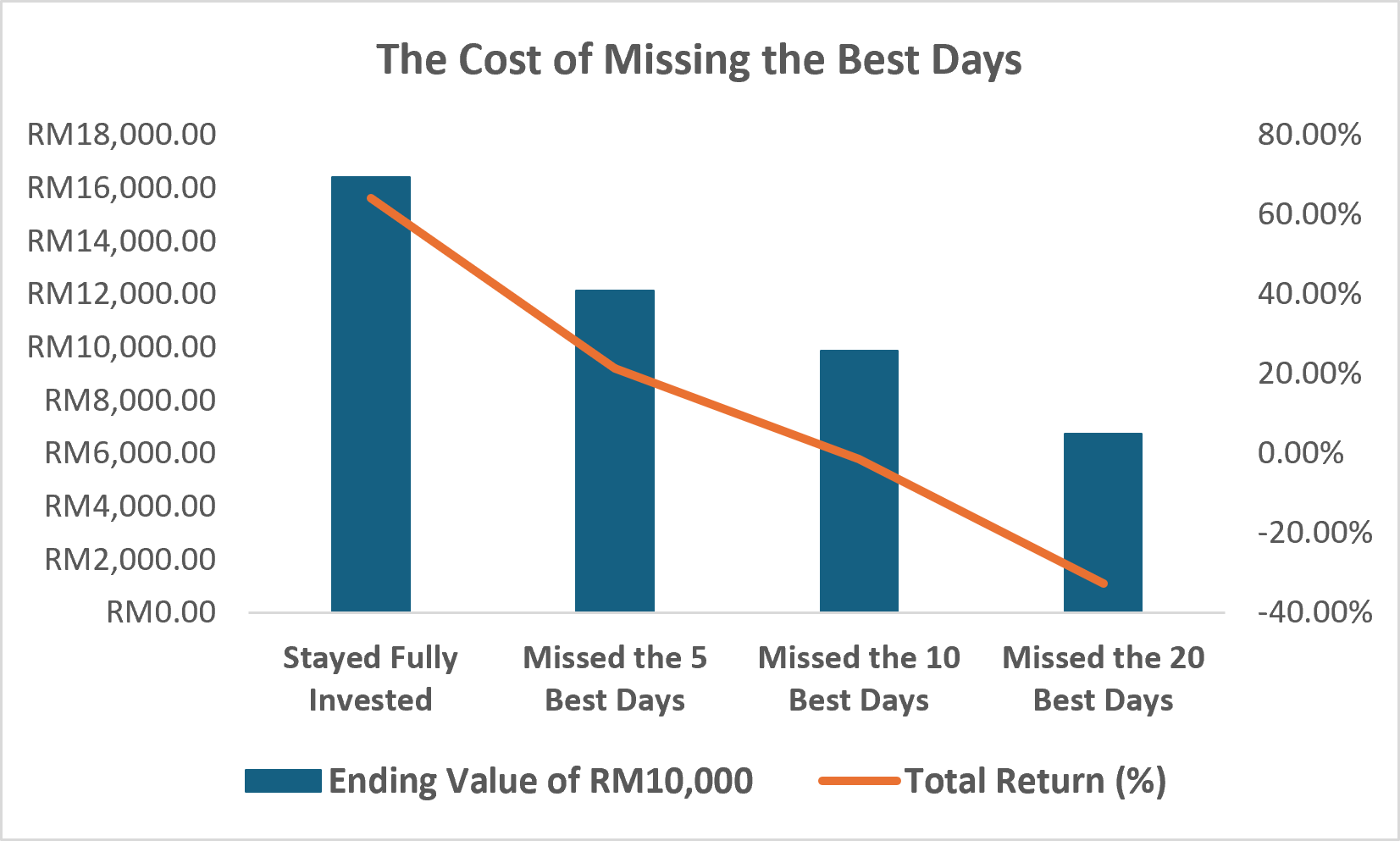
Figure 2: The cost of missing the best trading days.
When to Stay Invested and When to Switch Funds
Attempting to time the market can hurt long-term returns, especially when investors miss a few of the market’s best-performing days. Buy and hold works when the original reason for owning the fund remains valid. However, holding forever without review is not discipline; it is neglect. Investors should review a fund if it consistently underperforms its benchmark, the manager or strategy changes, fees become unreasonable, or personal goals change. A fund designed for long-term growth may not suit someone who now needs lower risk or regular income. Switching becomes a problem when decisions are based on comparison rather than evidence. A fund’s recent strong performance does not guarantee future success. Investors should switch only when the fund no longer matches their goals, risk level, or expectations. Chasing past winners can lead to selling after prices fall and buying after prices rise.
Conclusion: Hold With Review: A Balanced Approach to Investing
The smarter approach is not “never switch” or “always switch.” It is to stay invested while reviewing the fund regularly and objectively. Investors should compare the fund against a suitable benchmark, such as the FBM KLCI for Malaysian large-company equity funds, and evaluate performance over different periods rather than focusing only on the latest one-year return. They should also consider whether the fund still matches their goals, risk comfort, and investment purpose.
If weak performance is temporary and the original reason for owning the fund remains valid, patience may be the better choice. However, if the fund continues to underperform, its strategy changes, or it no longer meets the investor’s needs, switching may be justified. This approach keeps the strength of buy and hold, which is patience, while ensuring investors do not ignore important changes.
The reason staying invested matters is simple: markets often recover before confidence returns. When prices fall, fear can push investors to sell at the wrong time. However, the FBM KLCI has shown that difficult periods can be followed by strong recoveries. Investors who exit during downturns may miss the recovery that follows.
Therefore, successful investing requires both patience and awareness. Investors should give sound funds enough time to perform while reviewing them based on facts, not emotions. The key lesson is that time in the market is usually more valuable than trying to time the market.
Disclaimer
The information contained herein does not constitute an offer, invitation, or solicitation to invest in any product or service offered by Phillip Capital Management Sdn Bhd (“PCM”). No part of this document may be reproduced or circulated without prior written consent from PCM. This is not a unit trust or collective investment scheme and is not an obligation of, deposit in, or guaranteed by PCM. All investments carry risks, including the potential loss of principal.
Performance figures presented may reflect model portfolios and may differ from actual client accounts’ performance. Variations in individual clients’ portfolios against model portfolios and between one client’s portfolio to another can arise due to multiple factors, including (but not limited to) higher relative brokerage costs for smaller portfolios, timing of capital injections or withdrawals, timing of purchases and sales, and mandate change (e.g., Shariah vs. conventional). These differences may impact overall performance.
Past performance is not necessarily indicative of future returns. The value of investments may rise or fall, and returns are not guaranteed. PCM has not considered your investment objectives, financial situation, or particular needs. You are advised to consult a licensed financial adviser before making any investment decisions.
While all reasonable care has been taken to ensure the accuracy and completeness of the information contained herein, no representation or warranty is made, and no liability is accepted for any loss arising directly or indirectly from reliance on this material. This publication has not been reviewed by the Securities Commission Malaysia.
Prepared by: Amir Faruq Bin Khairul Anuar
Disclaimer: This content was prepared as part of an internship programme and reviewed prior to publication. It is intended for informational purposes only and does not constitute investment advice.