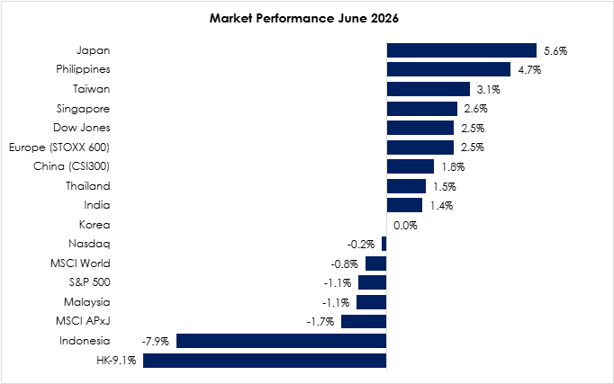
The MSCI Asia Pacific Ex-Japan Index (-1.7%) underperformed the MSCI World Index (-0.8%) as outsized declines in Hong Kong and Indonesia drag on the region. Philippines (+4.7%) managed to surge back up to flat year-to-date despite accelerating inflation and a weak peso. Taiwan (+3.1%) maintained its 2nd place within Asia Pacific for the 3rd month in-a-row, even as its National Development Council flagged an overheating economy for the 6th consecutive month. Singapore (+2.6%) trailed not far behind with strong electronics and wholesale trade activity supporting the economy. Hong Kong (-9.1%) suffered its biggest 1-month drop since Jan’24 even as its IPO market enjoyed an AI-driven boom from China AI and semiconductor firms. Indonesia (-7.9%) continued its stock market rout, as the government’s interventionist policies and a weakening rupiah cause investor and public confidence in its leadership to wane. Malaysia (-1.1%) large caps meanwhile struggle to match the growth of tech peers on account of normalising commodity prices prompting a rerating of commodity-driven names.
Exhibit 1: Market Performance June 2026
Source: Bloomberg, PCM, 30 June 2026
The MSCI World Index fell (-0.8%) during the month, as weakness in the US outweighed gains across other Developed Markets. Within Developed Markets, Japan (+5.6%) led market gains, supported by strong foreign investor inflows, continued progress in corporate governance reforms, and robust performance in AI-related semiconductor companies. These positive factors helped offset concerns over yen weakness, geopolitical tensions, and broader macroeconomic uncertainty, reinforcing investor confidence in the Japanese equity market. The US (-1.1%) declined during the month, as gains in large-cap technology stocks driven by continued optimism surrounding AI-related earnings growth were insufficient to offset broader market weakness amid elevated valuations and expectations that interest rates would remain higher for longer. Europe (+2.5%) posted solid returns, supported by resilient corporate earnings, improving investor sentiment, and easing concerns over geopolitical tensions and energy prices toward the end of the month, although persistent inflation and expectations of tighter monetary policy continued to temper market optimism.
On the monetary policy front, the Reserve Bank of Australia kept the official cash rate unchanged at 4.35% at its June 2026 policy meeting, maintaining a policy pause after its earlier tightening cycle. In ASEAN, Bank Indonesia delivered a surprise 25 bps rate hike on 9 June 2026, raising its benchmark interest rate to around 5.50%–5.75% in response to rupiah weakness and capital outflow pressures. The Bangko Sentral ng Pilipinas (Bangko Sentral ng Pilipinas) also resumed monetary tightening, lifting its policy rate by 25 bps to 4.75% at its Monetary Board decision amid renewed inflation concerns.
The FBMKLCI Index declined by 1.0% month-on-month (m-o-m) in June, closing at 1,665.91 points. Meanwhile, the FBM Hijrah Shariah Index fell by 2.3% in June, the Mid 70 Index fell by 3.4%, while the Small Cap Index declined by 0.8%. Sector-wise in June, the top-performing sectors were Plantation, Consumer, and Finance, which rose by 3.8%, 0.9%, and 0.8% m-o-m, respectively. The worst-performing sectors were Property, Healthcare, and Industrial Production, which declined by 10.6%, 8.8%, and 8.3% m-o-m, respectively.
Within the KLCI, the top three gainers for June were 99 Speed Mart Retail Holdings (+9.5%), YTL Power International Berhad (+9.0%), and Petronas Dagangan Bhd (+8.1%). Meanwhile, the top three decliners were Petronas Chemicals Group Berhad (-18.8%), Press Metal Aluminium Holdings (-14.8%), and CelcomDigi Bhd (-9.4%).
Foreign investors were net seller, with a net outflow of RM3.6 billion, bringing the year-to-date (YTD) outflows to RM1.9 billion. Separately, in June, there were eight listings on the Ace Market (Bus Cap Bhd, MM Computer Systems Bhd, Pentech Holdings Bhd, Elsa Bhd, Sum Technology Bhd, HSS Holdings Bhd, RT Pastry Holdings Bhd, Liftech Group Bhd),
For the month of June, WTI crude oil declined by 20.4% m-o-m to US$70.0 per barrel, while Brent crude fell by 21.0% m-o-m to US$73.0 per barrel. Crude palm oil gained to RM4,474/MT, down 0.10% from the previous month, while spot gold declined by 11.5% to US$4,038/oz. Currency-wise, the Malaysian ringgit depreciated by 3% m-o-m against the greenback to RM4.080/USD. Meanwhile, the Dollar Index rose by 2.27% to 101.2 points.
Equity Market Outlook & Investment Strategy
Malaysia
Malaysia’s macro backdrop in June remained broadly stable, supported by improving global risk sentiment, although domestic sentiment was partly influenced by heightened political attention ahead of the upcoming general election cycle. While election-related uncertainty led to periods of volatility in domestic equities, market reaction was overall measured, reflecting expectations of policy continuity and institutional stability. Easing global energy pressures and more diversified crude supply dynamics, partly supported by shifts in Russian export flows, helped moderate inflationary pressures and support domestic price stability. Nevertheless, we remain watchful of the second order inflationary effect arising from earlier increases in energy, logistics, and labour costs which could still lingered within certain industry. Against this backdrop, we remain constructive on selected domestic-oriented sectors, particularly those linked to rising electricity demand from data centre expansion and continued momentum in renewable energy investment. We are also increasingly positive on the technology sector as visibility in order flows improves, supported by sustained AI-related capital expenditure from global leaders. Accordingly, our strategy continues to favour a barbell approach anchored on large-cap, high-quality companies with strong balance sheets and reliable dividend yields, while selectively complemented by exposure to firms with clear earnings growth potential driven by structural thematic drivers.
Regional
Global markets navigated a more constructive environment as diplomatic efforts in the Middle East progressed, with a conditional ceasefire between the United States and Iran and gradual reopening of the Strait of Hormuz helping to stabilise energy markets and improve investor sentiment. While the situation remains fragile and supply chain disruptions persist, the risk of a broader regional escalation has eased for now. While AI remains a key driver of demand, growth is increasingly extending into adjacent areas, including semiconductor manufacturing, advanced memory (DRAM and HBM), networking equipment, and hyperscale data centre infrastructure. This sustained investment cycle continues to support the region’s technology supply chains, reinforcing the resilience of key export-oriented economies.
Beyond the digital theme, ongoing spending in power infrastructure, grid modernisation, industrial automation, and electrification is also emerging as an important complementary driver of growth, reflecting the scale of capital investment required to support rising electricity demand and longer-term productivity improvements Against this backdrop, while sector leadership continues to be supported by structural growth in technology and industrial themes, markets are becoming increasingly selective as valuations have moved higher and are now more sensitive to earnings delivery following strong performance year-to-date.
In this environment, we believe a barbell strategy that combines growth and income exposures, alongside broader diversification, remains well positioned to navigate volatility stemming from potential energy shocks, renewed inflationary pressures, and lingering uncertainties surrounding US tariff policies.
Fixed Income Outlook & Strategy
Malaysia
Looking ahead, global bond markets are expected to remain highly data-dependent, with investors closely monitoring inflation, labour market conditions, and central bank communications for clearer policy direction. While easing energy prices and moderating inflation pressures may reduce the urgency for further monetary tightening, resilient economic activity continues to support a cautious approach from major central banks. Against this backdrop, UST yields are expected to remain broadly range-bound with a slight downward bias, while Malaysian government bonds should continue to be supported by resilient domestic growth, stable inflation, favourable liquidity conditions, and ongoing foreign investor participation. Overall, the local fixed income market remains well-positioned to weather external uncertainties, with MGS yields likely to remain anchored around current levels in the near term.
Regional
The U.S. Treasury market experienced significant volatility during June 2026 as investors navigated shifting expectations surrounding Federal Reserve policy, geopolitical developments in the Middle East, and evolving inflation dynamics. Early in the month, resilient economic data, elevated oil prices driven by tensions around the Strait of Hormuz, and persistent inflation concerns reinforced the market’s higher-for-longer interest-rate narrative, pushing Treasury yields higher. However, sentiment improved during the latter half of the month following the easing of geopolitical tensions, the reopening of key energy supply routes, and a sharp decline in oil prices, which helped alleviate inflation concerns and renew demand for duration. As a result, the benchmark 10-year UST yield retreated from its mid-month highs and closed June at approximately 4.40%, reflecting a gradual shift in investor focus from inflation risks towards moderating growth prospects and softer underlying economic momentum.
The Bank of Japan (BOJ) maintained its gradual policy normalization path during June 2026, with market participants increasingly pricing in another rate hike amid persistent inflationary pressures and continued yen weakness. BOJ Governor Kazuo Ueda’s remarks reinforced expectations that monetary policy will be tightened further should inflation remain sustainably above target. The Japanese yen continued to trade near multi-decade lows against the U.S. dollar, reflecting the widening interest rate differential between Japan and the United States, although expectations of future BOJ tightening provided some support to the currency.
The European Central Bank (ECB) raised its deposit rate by 25 basis points in June 2026, marking its first rate hike since 2023, as policymakers responded to rising inflationary pressures stemming from higher energy prices and geopolitical tensions in the Middle East. Reflecting a more challenging inflation outlook, the ECB revised its inflation forecasts upward to 3.0% for 2026 and 2.3% for 2027, while reaffirming its commitment to returning inflation to its 2% medium-term target.
Strategy for the month
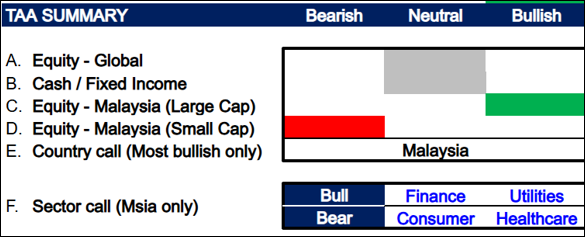
We adopt a neutral stance on global equities, particularly the U.S., underpinned by the resilience of the U.S. economy, healthy domestic consumption, and its position as a major energy producer and net exporter. While AI valuation concerns have eased, elevated broader market valuations continue to limit upside, supporting our neutral stance. However, we remain constructive on Malaysian equities, supported by resilient domestic demand, attractive dividend yields, and improving investor sentiment amid a more supportive global rate outlook. Expectations of further monetary easing globally could provide greater policy flexibility for Asian central banks, while Malaysia’s ongoing investment cycle, particularly in infrastructure, data centres, and key domestic sectors, continues to support medium-term growth prospects.
In Malaysia, we remain bullish on large-cap equities and bearish on small-cap equities. Sector-wise, we overweight the Banking and Utilities sectors. Banking remains well positioned in a higher-for-longer interest rate environment, supported by resilient net interest margins, healthy loan growth and stable asset quality. Meanwhile, the Utilities sector is expected to benefit from its defensive earnings profile, stable cash flows and supportive regulatory framework, making it an attractive sector amid ongoing macroeconomic uncertainties. Meanwhile, we remain bearish on the Consumer sector could face margin pressures from uncertainty surrounding second-order inflation effects, as higher operating costs may be difficult to fully pass on to consumers, Healthcare sector, particularly glove manufacturers, as persistent industry oversupply and continued pressure on average selling prices (ASPs) are likely to weigh on earnings recovery.
Exhibit 2: PCM’s monthly strategy snapshot
Source: PCM, 30 June 2026
Phillip Capital Malaysia and our offerings
We reaffirm our belief that there are still opportunities in the market, and we maintain a discerning approach in choosing high-quality stocks for our portfolio. However, it is crucial to exercise caution and carefully select investment options to ensure the best risk-adjusted returns. By taking a vigilant and discerning approach, investors can potentially reap the benefits of the current market opportunities while minimising risks.
A noteworthy avenue for investors seeking diversification in their portfolio is through PhillipCapital Malaysia. PhillipCapital Malaysia offers multiple private mandate services managed by professional fund managers. By leveraging PhillipCapital Malaysia’s private mandate services, investors can enhance their resiliency, optimise portfolio performance, and navigate the complexities of the market with confidence.
We also offer both conventional and Shariah-compliant options to cater to the needs of all investors. For Malaysia’s mandates, we like:
1. PMART/PMA Dividend Enhanced and/or PMART/PMA Dividend Enhanced ESG
Our PMART Dividend Enhanced and PMA Dividend Enhanced is an income-driven portfolio focused on high dividend-yielding equities. We apply the Dog of the Dow approach, screen and select top market cap stocks to minimise risk and ensure consistent performance. The portfolio is an equal weighting portfolio which reduces concentration risk and provides similar exposure to all clients, both initially and after rebalancing. We offer both conventional and Shariah investment options to cater to the diverse needs of our investors. Click here to learn more. We recently also introduced PMART/PMA Dividend Enhanced ESG Mandate as we remain dedicated to investing in ESG stocks given their stronger valuation and profitability.
2. PMART/PMA ESG
Phillip Capital Malaysia offers discretionary portfolio that invests in stocks with high ESG ratings from the F4GBM and F4GBMS Indices, namely PMART and PMA ESG. There are both conventional and Shariah options available. To explore the companies in which both Conventional and Shariah ESG mandates invest, you can refer to the provided link.
3. PMART/PMA Blue Chip and Opportunity
Our Blue-Chip portfolios primarily allocate our investments towards companies with large market capitalisations, while the Opportunity portfolios predominantly invest in companies with smaller market capitalisations. We also offer both conventional and Shariah-compliant options to cater to the needs of all investors.
Please click on the link to learn more or email us at cse.my@phillipcapital.com.my if you require any further information.
Tactical Asset Allocation
Tactical Asset Allocation_Powerpoint
Disclaimer
The information contained herein does not constitute an offer, invitation, or solicitation to invest in any product or service offered by Phillip Capital Management Sdn Bhd (“PCM”). No part of this document may be reproduced or circulated without prior written consent from PCM. This is not a unit trust or collective investment scheme and is not an obligation of, deposit in, or guaranteed by PCM. All investments carry risks, including the potential loss of principal.
Performance figures presented may reflect model portfolios and may differ from actual client accounts’ performance. Variations in individual clients’ portfolios against model portfolios and between one client’s portfolio to another can arise due to multiple factors, including (but not limited to) higher relative brokerage costs for smaller portfolios, timing of capital injections or withdrawals, timing of purchases and sales, and mandate change (e.g., Shariah vs. conventional). These differences may impact overall performance.
Past performance is not necessarily indicative of future returns. The value of investments may rise or fall, and returns are not guaranteed. PCM has not considered your investment objectives, financial situation, or particular needs. You are advised to consult a licensed financial adviser before making any investment decisions.
While all reasonable care has been taken to ensure the accuracy and completeness of the information contained herein, no representation or warranty is made, and no liability is accepted for any loss arising directly or indirectly from reliance on this material. This publication has not been reviewed by the Securities Commission Malaysia.